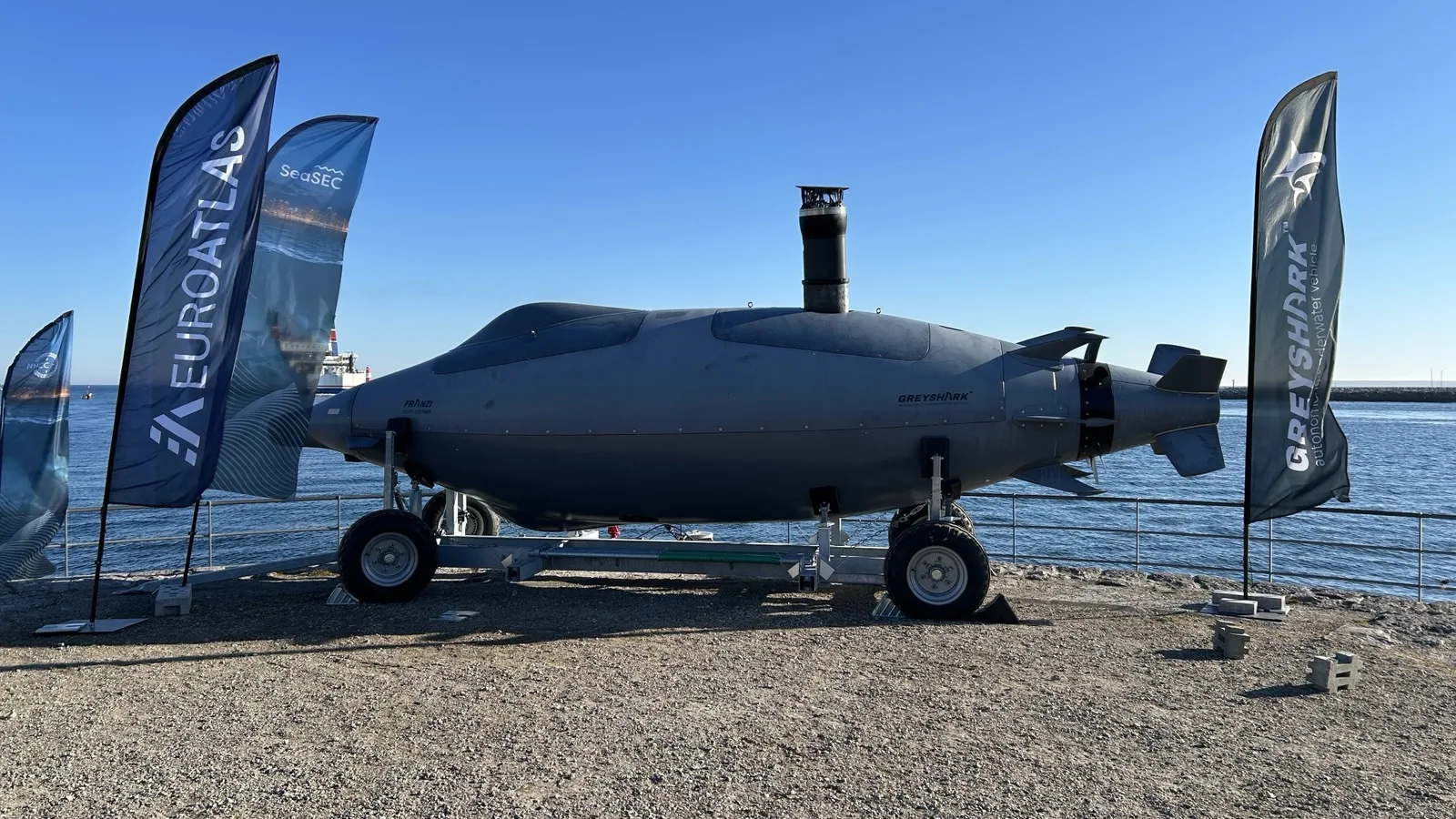
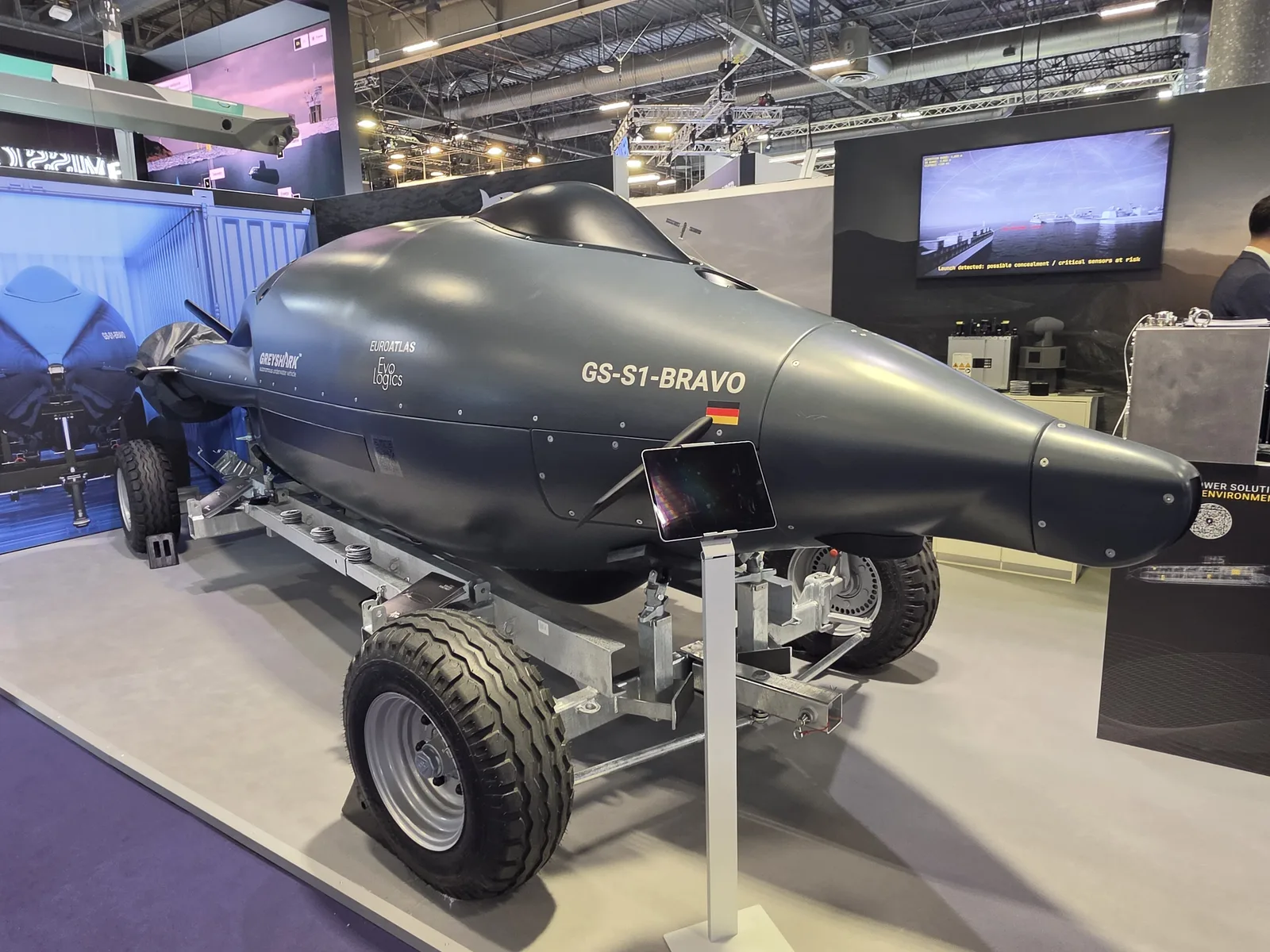
German defence companies Euroatlas and EvoLogics unveiled the first series-production Greyshark autonomous underwater vehicle (AUV) at Euronaval 2026, held in Paris from 3-6 November.
The Greyshark unit presented was an S1-Bravo variant, the ‘B’ denoting the battery-powered version. A second variant – the fuel-cell-powered S1-Foxtrot (the ‘F’ denoting fuel-cell) – is in final prototyping stages, in preparation for also transitioning to series production.
In a statement issued at Euronaval the two companies added that the first Greyshark orders had been secured from European government customers, with initial deliveries scheduled to be fulfilled before the end of 2026.
In the statement Euroatlas Managing Director Eugen Ciemnyjewski said, “The challenge in defence innovation is not only to develop advanced technology, but to translate it into operational capabilities that can be produced and delivered at scale. Moving Greyshark from prototype to series production in two years is an important step in that direction.”
EvoLogics Managing Director Fabian Bannasch added, “The positive feedback …. [in] past months has confirmed we are closing an important technological gap. We offer a state-of-the-art, covert and endurance-capable solution for maritime reconnaissance and the effective protection of critical underwater infrastructure (CUI).”
Greyshark mission capability
The statement itself pointed to navies’ operational need to expand underwater surveillance, strengthen maritime domain awareness (MDA) and secure CUI. It underlined Greyshark’s capacity, in supporting these tasks, to deliver multi-mission capability with range and endurance: the Bravo variant can achieve a 300 nautical mile (556 km) range at 4 kt (7.4 km/h) speeds and can deploy for up to five days, depending on mission outputs; these range and endurance statistics are set to increase with the Foxtrot variant.
The statement also noted Greyshark’s 10 kt (18.5 km/h) cruising and faster-still sprinting speeds. Such speeds enable the AUV to deploy rapidly to, and across, operational areas.
NATO navies are increasingly focused on the collective underwater warfare (UWW) challenge – the integrated combination of anti-submarine warfare (ASW), CUI, and mine countermeasures (MCM) requirements, with tactical and capability overlaps existing between these tasks. The statement highlighted Greyshark’s CUI and MCM capabilities, along with its intelligence, surveillance, and reconnaissance (ISR) output, which is critical within all three UWW tasks.
Talking to Warsight at Euronaval, Ciemnyjewski underscored the AUV’s MCM and ASW contributions, plus its input into CUI security and general shipping lane monitoring.
Regarding MCM, he said, “Across the whole range of the [task], we can find anomalies on the seabed.” Anomaly data can be processed on board the AUV and then sent on as information; alternatively, the raw data can be offboarded directly to operators. Next – either automatically, semi-automatically or prompted by operators – Greyshark can conduct verification, using sonar or laser imagery, still pictures or live video streaming, Ciemnyjewski explained.
Going forward, if required by customers, the AUV could carry mine disposal effectors, fitted to its underside for dropping alongside a mine target.
For ASW, Ciemnyjewski said, Greyshark’s current task is “classic finding a submarine”. Using a clip-on towed-array sonar system, the AUV monitors areas of interest and reports back any contacts in a data format operators can use, he explained.
Euroatlas explained to Warsight that it is evaluating a specific compact towed array for fitting to Greyshark, but that customers’ preferred arrays can also be considered, subject to an engineering assessment (with potential constraints including the array’s diameter and length, plus how tightly it can be coiled to fit within the AUV).
Future ASW options – also depending on customer requirements – could again include adding an effector or enhancing capability to hunt other AUVs, Ciemnyjewski said.
In the latter context, the Greyshark product brochure notes the Bravo variant could be developed to bw capable of diving down to 4,000 m depths. “If we can go down to 4,000 m in theory, then adversary AUVs can do the same,” Ciemnyjewski said. “An adversary AUV potentially could sneak up on the bottom of the sea; somebody needs to find it and neutralise it.” To deliver this capability, the Greyshark Bravo would need some re-design work; Ciemnyjewski added this would only be done with a customer order.
Another component of Greyshark’s counter-AUV capability is its own sonar sensing, with the sensor being required to detect an AUV of similar size. Euroatlas confirmed to Warsight that Greyshark’s current synthetic aperture sonar (SAS) can detect an object the size of another Greyshark at short range. In collaboration with other sensors, it can also support wide-area search for other AUVs.
A swarm capability
Another attribute Greyshark already brings is what the statement called advanced autonomous swarm capability.
“Multiple vehicles can form a dynamic underwater network and communicate with each other in real time via encrypted S2C [sweep-spread carrier] underwater acoustics,” the statement said. This includes automated data sharing and task distribution.
“We always recommend operating in a swarm,” Ciemnyjewski told Warsight. “Greyshark is swarm-capable, so we could create a real barrier for very low cost.”
EvoLogics provides Greyshark’s command-and-control (C2) suite, including the S2C technology.