After trailing its development to invited journalists at the Swedish Air Force’s Jubilee Air Show at Malmen Air Base in Linköping in August 2026, Saab has now officially unveiled its AI Fighter Pilot Academy (AIFPA).


After trailing its development to invited journalists at the Swedish Air Force’s Jubilee Air Show at Malmen Air Base in Linköping in August 2026, Saab has now officially unveiled its AI Fighter Pilot Academy (AIFPA).
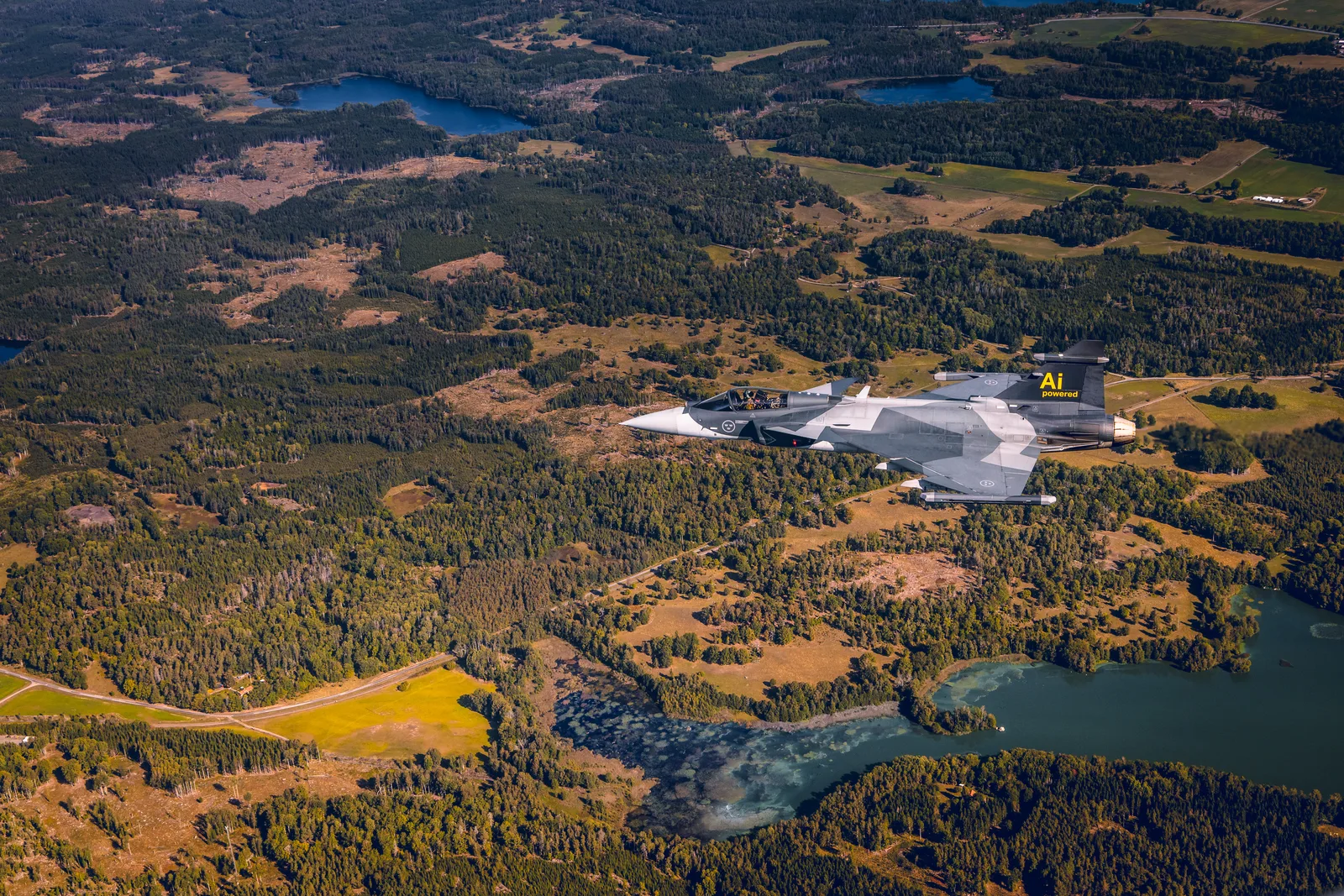
Sweden’s Saab has officially unveiled its Artificial Intelligence Fighter Pilot Academy (AIFPA) and announced that its own in-house, AI agents have been flown on the Gripen E fighter since 2025.
The capability demonstrates Saab’s ability to develop, train and fly its own AI for air combat, taking it all the way from concept to operational use.
During an embargoed online press briefing to select journalists on 30 October 2026, Saab’s head of advanced programmes, Peter Nilsson, stated, “We can prove that something was possible. The harder question is how we turn this success into a dependable capability that can learn, improve and be relevant over time, and that is the true purpose of AI Fighter Pilot Academy. It is Saab’s approach to industrialising the development of our own AI agents for future platforms.”
The concept moves Saab on from its experimentation in 2025 with the Centaur AI agent provided by Germany’s Helsing. On 28 May 2025 Saab flew a Gripen E with Centaur on board for the first time. During that and subsequent flights, which were conducted in controlled airspace, the Gripen E gave control to the Centaur AI agent, which successfully autonomously executed complex manoeuvres in a beyond-visual-range (BVR) combat scenario, cueing the pilot to fire on a manned Gripen D acting as an adversary.
Nilsson noted that what Saab learned through its own research and with its experience in deploying Centaur on the Gripen E was that there were three conditions required for AI agents in fighters to create real capability:
Along with AstraZeneca, Ericsson, SEB and Wallenberg Investments, Saab is a founder of Sferical AI: a Swedish sovereign AI initiative launched in mid-2025 that provides secure, large-scale computing capacity for advanced AI development. Through Sferical AI Saab has been able to use its own supercomputer based in Linköping to develop its AI agents. This features an Nvidia DGX PuperPOD architecture using a 16-rack set-up and runs on 1,152 Nvidia Grace Blackwell GB300 and Ultra graphics processing units (GPUs) to manage heavy, large-scale multi-model training and advanced inference.
What this means, Nilsson explained, is that whereas before Saab was flying an AI agent in a simulator for one hour and being able to scale this to 1,200 hours, now that one hour can be scaled to a billion hours.
“The exponential curve is just really hard to comprehend,” said Nilsson. “The strategic advantage increasingly comes from reducing the distance between experience learning and fielded capability: the industrial OODA [observe, orient, decide, act] loop. The key question is therefore: ‘How do we industrialise that learning cycle without compromising evidence, control, of flight validation?’, and AI Fighter Pilot Academy is Saab’s answer to that question.”
Nilsson explained that AIFPA “connects four activities in one repeatable loop. We develop and adapt Saab’s AI agents around defined operational needs. We train them in large-scale, high-fidelity simulations. We challenge them across demanding and degraded conditions, and we assure the result by building evidence before we test them in aircraft.
“Industrial capability means repeatability, governance, evidence and continuous improvement,” he said. “The value is not in any way activity; it’s in connecting them together.”
Using the latest DGX SuperPOD technology delivered through Sferical AI, AIFPA is able to train reinforcement-learning agents at unprecedented scale; develop large language model/vision-language model (LMM/VLM) capabilities to support communication between the AI agent and the operator; run massive, high-fidelity multi-domain simulations in parallel; iterate tactics, behaviours and decision-making cycles in close co-operation with warfighters; and seamlessly move data between simulation, training, validation pipelines and test flights in the Gripen E.
“The aim is not to replace flight testing, but to make scarce flight test resources activity more focused and informative,” said Nilsson. “This matters because air combat is not a clean, fully observable game.”
Nilsson noted three important verbs: develop, integrate, and assure.
Regarding the latter, he noted, “We are pretty sure, talking to air forces, that they need to be assured. They need evidence. How have you trained your agents? Is it aggressive? Is it offensive? Does it follow the laws of war and Geneva Convention, rules of engagement etc? So trust is a very important thing, and therefore you can’t have a closed environment, a closed approach. You have to be able to prove, and talk, and be transparent in how they are trained. And it’s not just for one one aircraft; it is around multi-mission, multi-platform [operations].”
Nilsson noted that the greatest intended outcome in employing AIFPA is “dependable tactical competence”.
“The capability must support rapid decision making within mission timescales, tactical reasoning with defined intent and boundaries, and collaboration with people, aircraft and other agents,” he said. “It must also produce sufficiently consistent and available behaviour across the intended operating envelope. That brings us slightly into large language models, and maybe not just reinforcement learning. Trust is also not a label applied in the end; it’s built through the full training, testing, assurance, and validation process. This is why ‘observe, learn, and share’ is a continuous loop.”
Asked when the AIFPA capability could be rolled out, Nilsson replied, “That’s today; we’re already up and running with this.” He cautioned, however, that its development “puts some demand on the customer”, in that the Swedish Defence Materiel Administration (FMV) and the Swedish Air Force will need to determine how to exploit it.