
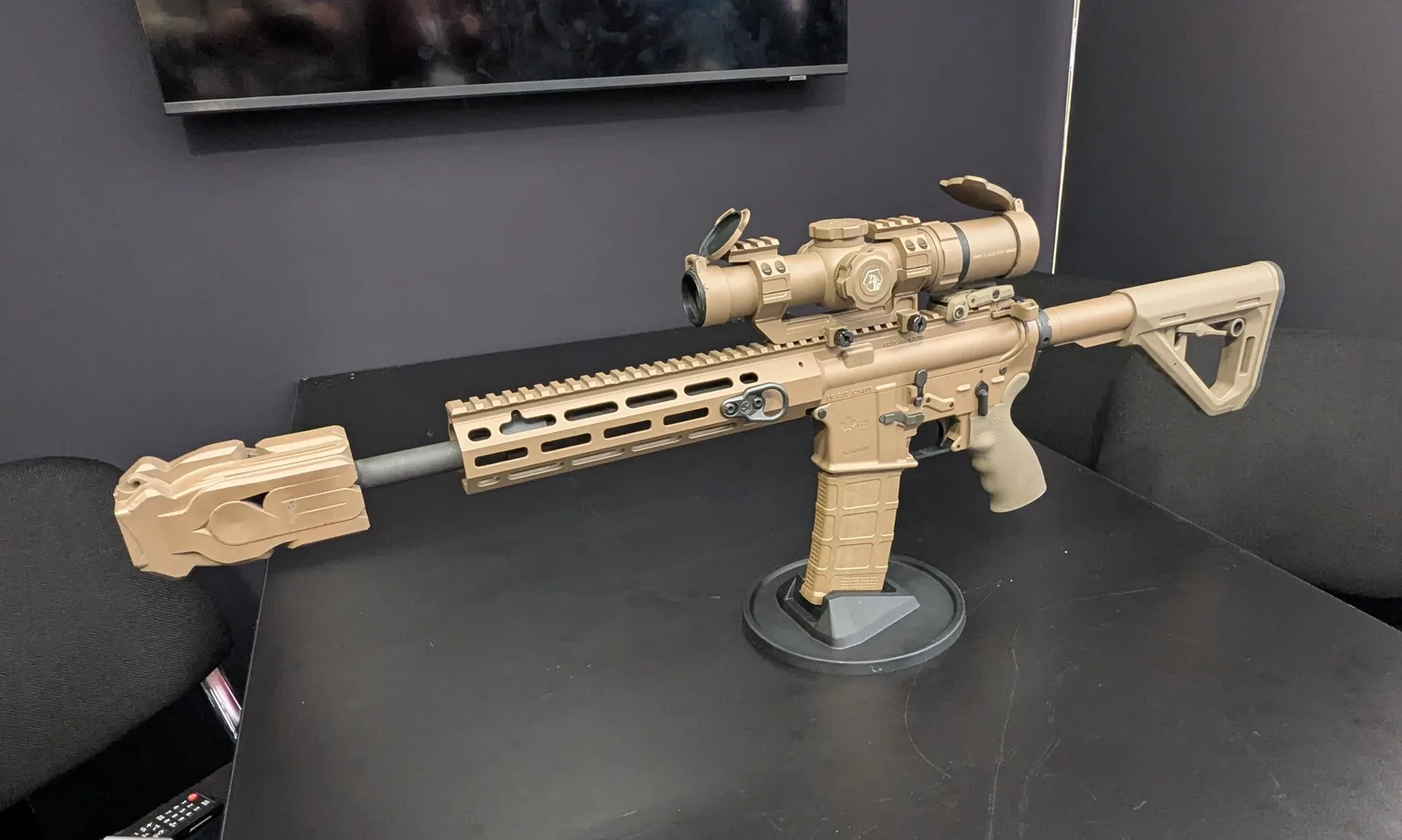
Colt Canada introduced its C25 assault rifle to a UK audience at DVD 2026, held at held at the UTAC Millbrook Proving Ground in Bedfordshire from 16-17 September, positioning the weapon as a contender for the UK’s Project Grayburn: the effort to replace the UK armed forces’ SA80 family of rifles from around 2030.
Under the Canadian Modular Assault Rifle (CMAR) project, the 5.56 mm-chambered C25 was officially selected in March 2026 by the Canadian Department of National Defence to replace the Canadian Armed Forces’ C7/C8 5.56 mm service weapons, which were introduced in 1984. Colt Canada has been awarded a CAD 307 million (EUR 191 million) contract for the first 30,000 C25 weapons.
The C25 addresses the challenge of defeating Level IV body armour, which is increasingly prevalent on the modern battlefield and which Colt Canada notes cannot be reliably defeated by the standard NATO 5.56 mm cartridge.
However, while a new intermediate calibre between the NATO-standard 5.56 mm and 7.62 mm cartridges is currently the subject of much international debate, with the C25 rifle Colt Canada is taking a different approach.
“With no settled view yet on a next-generation intermediate calibre,” the company stated in a 16 September press release, “Colt Canada, in line with Canadian Department for National Defence operational doctrine and employment, has approached the gap from a different perspective: making the soldier dramatically more accurate against the smaller, harder targets that armour leaves exposed, under the fatigue and stress of sustained operations,” adding that the C25 “is a precision and human-factors programme built around a defined concept of employment”.
Colt Canada has thus taken a number of measures to ensure a soldier firing the C25, even under duress, can be as accurate as possible.
Speaking to Warsight at DVD 2026 on 16 September, Timothy Moore, head of international business development for Colt Canada, outlined the key features that the company has implemented with the C25.
Firstly, Moore noted that, as a gas-operated rifle derived from the mechanism originally designed by US firearm designer Eugene Stoner for the ArmaLite AR-15/M16 rifle in the 1950s, the C25 is inherently more centrally balanced than rifles that use a piston mechanism in the front end of the rifle.
Beyond this, however, Moore said Colt Canada implemented four key features in the C25. Firstly, the company moved from using a single-stage trigger to a two-stage trigger, giving the firer more sensitivity and a much greater expectation for when a round will be fired.
Secondly, the C25, which has a 13.7-inch (348 mm) chrome-lined, free-floating, cold-hammer-forged barrel that is optimised for durability and sustained performance, features optimised barrel geometry that reduces disturbance to the projectile, supporting
Colt Canada introduced its C25 assault rifle to a UK audience at DVD 2026, held at held at the UTAC Millbrook Proving Ground in Bedfordshire from 16-17 September, positioning the weapon as a contender for the UK’s Project Grayburn: the effort to replace the UK armed forces’ SA80 family of rifles from around 2030.
Under the Canadian Modular Assault Rifle (CMAR) project, the 5.56 mm-chambered C25 was officially selected in March 2026 by the Canadian Department of National Defence to replace the Canadian Armed Forces’ C7/C8 5.56 mm service weapons, which were introduced in 1984. Colt Canada has been awarded a CAD 307 million (EUR 191 million) contract for the first 30,000 C25 weapons.
The C25 addresses the challenge of defeating Level IV body armour, which is increasingly prevalent on the modern battlefield and which Colt Canada notes cannot be reliably defeated by the standard NATO 5.56 mm cartridge.
However, while a new intermediate calibre between the NATO-standard 5.56 mm and 7.62 mm cartridges is currently the subject of much international debate, with the C25 rifle Colt Canada is taking a different approach.
“With no settled view yet on a next-generation intermediate calibre,” the company stated in a 16 September press release, “Colt Canada, in line with Canadian Department for National Defence operational doctrine and employment, has approached the gap from a different perspective: making the soldier dramatically more accurate against the smaller, harder targets that armour leaves exposed, under the fatigue and stress of sustained operations,” adding that the C25 “is a precision and human-factors programme built around a defined concept of employment”.
Colt Canada has thus taken a number of measures to ensure a soldier firing the C25, even under duress, can be as accurate as possible.
Speaking to Warsight at DVD 2026 on 16 September, Timothy Moore, head of international business development for Colt Canada, outlined the key features that the company has implemented with the C25.
Firstly, Moore noted that, as a gas-operated rifle derived from the mechanism originally designed by US firearm designer Eugene Stoner for the ArmaLite AR-15/M16 rifle in the 1950s, the C25 is inherently more centrally balanced than rifles that use a piston mechanism in the front end of the rifle.
Beyond this, however, Moore said Colt Canada implemented four key features in the C25. Firstly, the company moved from using a single-stage trigger to a two-stage trigger, giving the firer more sensitivity and a much greater expectation for when a round will be fired.
Secondly, the C25, which has a 13.7-inch (348 mm) chrome-lined, free-floating, cold-hammer-forged barrel that is optimised for durability and sustained performance, features optimised barrel geometry that reduces disturbance to the projectile, supporting higher practical accuracy.
A third and notable feature of the C25 is its Multi-Function Muzzle Device (MFMD). This component, designed by US company Strategic Sciences and 3D-manufactured by partner Canadian company Millbrook Strategic Sciences, performs four functions: flash suppression, recoil reduction, sound suppression and reduction of the firer being exposed to noxious gases.
Lastly, Moore noted, the C25 features a Colt Low Power Variable Optic (LPVO) with 1 to 6× magnification, which supports faster target acquisition by offering a greater magnification than other sights in typical while not requiring the firer to choose between one fixed magnification and another.

Project Grayburn: waiting for the starting gun
Project Grayburn is still in its concept/assessment phase, or what the UK Ministry of Defence (MoD) refers to as a Position and Intended Movement (PIM) phase. The MoD has thus far stated that it is looking for five key weapon variants sharing a common lower receiver: a standard dismounted close combat rifle (SA80A3 replacement); a short dismounted close combat variant; a personal defence weapon (L22 carbine replacement); a generalist rifle (SA80A2 replacement); and a cadet rifle (L98 replacement).
Numerous companies have so far signalled their intention to bid, including: Beretta Defence Technologies UK, with both its New Assault Rifle Platform (NARP) and Sako M23 rifle; SIG Sauer, which can offer its MCX and XM7 weapons; Heckler & Koch, offering the HK416 and HK433 weapons; FN Herstal, proposing its ARKA rifle, which is an evolution of the company’s SCAR weapon; and even India’s SSS Defence, which produces a range of 5.56 mm- and 7.62 mm-chambered assault rifles.
While the MoD has stipulated that the required weapon must be capable of defeating modern body armour and ideally be manufactured within the UK to secure domestic supply chains and create jobs, it has conspicuously not yet identified a required calibre, and yet it is expected to do so.
Asked by Warsight what Colt Defense’s response will be if the UK MoD ultimately specifies an intermediate calibre, Moore replied that he is “not at liberty to discuss intermediate calibres and our development pathway”.
Project Grayburn represents a once-in-a-generation opportunity to provide the UK armed forces with the optimum personal weapons they will need to carry onto the battlefield for many decades to come. The downselection will be a truly momentous decision.
Editor’s note: Warsight will soon have the opportunity, through a press facility organised by Colt Canada, to take a closer look at the C25 rifle and also to fire the weapon on a range. Stay tuned!