At the NATO Edge 26 event in İzmir, Türkiye, on 17 November Ukrainian Minister for Digital Transformation Oksana Ferchuk delivered a keynote address outlining 10 lessons and challenges for NATO in maintaining and advancing digital transformation as a result of Ukraine’s experiences in repelling Russia’s offensive against the country.
NATO Edge 26: Ukrainian Minister for Digital Transformation delivers lessons learned the hard way

Ukrainian Minister for Digital Transformation Oksana Ferchuk delivering her keynote speech at the NATO Edge 26 event in İzmir, Türkiye, on 17 November, in which she presented 10 lessons and challenges for NATO in maintaining and advancing digital transformation informed by Ukraine's wartime experiences. (NCIA)
At the NATO Communications and Information Agency’s NATO Edge 26 event in İzmir, Türkiye, on 17 November a keynote speech was delivered by Ukrainian Minister for Digital Transformation Oksana Ferchuk.
After thanking NATO for its continued support in stemming the Russian offensive against her country, Ferchuk presented 10 lessons and challenges for NATO in maintaining and advancing digital transformation that Ukraine has learned the hard way, while under constant Russian bombardment.
She noted, for example, that that very morning Russia had attacked a number of bridges in Kyiv, affecting Ukrainian connectivity as a result, but added that “immediately, in a couple of minutes, it was rerouted, it was restructured, and all our digital infrastructure is working despite the attacks”.
Firstly, Ferchuk noted that since September 2026 the Russians had made a strategic move to try to destroy Ukraine’s digital infrastructure.
“They started to attack our data centres, mobile operators, connectivity points: everything which relates to the physical digital infrastructure,” she said. “You probably observed that, as a result, no military or civil state-owned service was destroyed or [suffered an] outage. Why? Because we were prepared. How we were preparing for it, I will tell you in a minute, but what is important on this first point is that you should consider that any on-the-ground facilities can be destroyed, since the enemy has the weapons and the instruments to reach out.”
Secondly, Ferchuk stressed the need to have connectivity at every layer.
“You should not rely on one or two or even three types of connectivity,” she said. “The more you have, the better. The beauty is that different types of connectivity are best suitable for different types of missions or equipment or the situation. This is why we are taking care about mobile networks, both military and civil. We are taking care about satellite [connectivity], and it’s very important that in every area you should not rely on one provider. It doesn’t matter in which area; you should have always a double-asset option to be more flexible. Of course, radio is staying as one of the important issues, and mesh networks are also important … and don’t forget about fixed-line [communications], which if your front line is not moving very fast is one of the most effective and most reliable areas for connectivity.”
Ferchuk’s third point related to protecting state information systems.
“Again, I will mention that, despite the fact that Russia was attacking all digital infrastructure, no state or military-owned system was down because we designed it from the very beginning to be resilient to such attacks, and to be available even when our infrastructure is destroyed,” she noted. “There is a state policy in Ukraine obliging state companies and state bodies to [protect] all of the system. We do the [protection] in at least three dimensions. We have on-premise data centres, yes, but we also put in systems into the cloud. We have Ukrainian cloud providers, and we are also reserving for the hot instances international cloud providers. We also do back-ups, and back-ups are stored underground. And we do regular tests. This is how our teams are prepared for disaster, and disaster is happening every moment.”
Turning to cyber security, Ferchuk stated, “This is one of the front lines which is currently not only between Russia and Ukraine; it’s already between a lot of enemies like Russia and the NATO alliance and other European countries. What is important to understand is we are as intensive on that front line as on the physical front line, and the changes we observe now is the involvement of AI instruments. What is the difference? The difference is that the attacks become more massive; they become cheaper. We see them literally every day. They are attacking at the same time dozens of our systems, and when they find vulnerabilities, they also use AI in order to immediately change the landscape and damage the infrastructure inside. In order to be resistant, in order to be able to protect, you cannot rely on the human mind anymore. You should use other instruments, which are detecting and which are analysing this information in front of you, giving the right information to the people who are making decisions.”
Ferchuk then emphasised that the private sector is as critical as the state sector.
“It’s not so visible, but if we are speaking about the full-scale war, it’s not only the military men who are important; it’s also civilians who are living in your country who are important, and they are using digital services – from the banking system, postal service, shopping, electronic commerce – and those private services become also crucial and important. And they are unfortunately sometimes less prepared for such cyber attacks, so we should take care and we should learn and teach the market how to protect important, major digital systems in the private sector as well.”
Turning to critical infrastructure coming under attack, Ferchuk said, “One of the most painful points for me now, since Russia is not pretending anymore that they are working only on the military landscape, they are actively destroying the civil infrastructure. And we see again this morning they are destroying bridges in big cities in order to paralyse our traffic and logistics. They are attacking transport. They are even bombing the Metro, the [train] stations in Kyiv. They are constantly, every day, attacking our railways.”
Ferchuk noted that the CEO of Ukrainian Railways has stated that, thus far in 2026, there had only been 19 days when the railways were not attacked by Russia.
“You can understand how severely they are trying to paralyse the transport and logistics and, of course, it affects everything,” she said. “Everything around is connected.”
Ferchuk pointed out that in October Russia began to especially target Ukraine’s energy sector. “They are trying to cut off our biggest cities [from] energy again, trying to put the mass negative impact on our society. Water supply, heating supply. This is what they are doing,” she said. “And if you are a country, a state, or the armed forces protecting your country, you should take care about all of those components, since they are keeping your society alive, your country alive, and, at the end of the day, your military troops alive as well.”
The Ukrainian recipe for countering this situation, Ferchuk explained, is rapid research and development, being fast and flexible and innovating ‘on the fly’.
“In each area which I showed you – railways, transport, bridges, whatever – we are innovating every second,” she explained. “I mentioned this morning when the Ukrainian state or a Ukrainian military unit is receiving a problem or challenge or task, we are not relying on one solution or answer; we are always setting up several and then executing several and then seeing which of them is suiting the best, which of them is supplied with resources in the best way. This is the answer: to be very fast, to be very flexible. Don’t be afraid to make a mistake in such a situation. You do a mistake, it’s normal, but then you should learn from your mistake and you should be as fast as possible.”
The minister then noted how Ukraine is using co-ordination activities such as through its Brave1 accelerator programme, “which is taking from the military side the ideas and the challenges and bringing them to start-up companies and to the [military technology sector], “since the universe of mil-tech companies are very well positioned to use the IT infrastructure and the IT methods and IT approach”.
Ferchuk then stressed the need to transform procurement practices, noting that agile procurement was a key tenet at NATO Edge 26. “I do believe that the fastest way is to change your procurement methods,” she said, “to change what you are procuring, to change how you are procuring, to change the approach to procuring something which has already a result on the battlefield, and the result is actually confirmed by the military man who is using it.”
Lastly, Ferchuk stressed the need for the front line to be online and powered by AI.
“Currently, the Ukrainian front line is fully online,” she said. “This is why, again, connectivity is important. And in this digital age, in this digital segment, we already have a lot of AI-powered capabilities. We analyse a lot of data. We have embedded AI, which is bringing autonomous modes into all of our equipment, and this wave of using AI will be increasing massively, since this technology is showing a lot of effectiveness.
“I really hear from some of our European colleagues that they are afraid and still thinking whether to use or not to use AI at massive scale, and I believe that the mood of this question should be changed,” Ferchuk asserted. “You should not think about whether to use it or not. You should just think how to use it faster, to be faster than our enemies, and to learn from the mistakes, and in three five years to understand that it’s just a great instrument, like the internet was before, or mobile [phones] were before, which we are happy to use to help us to keep our European values, to keep our society, and to protect our countries and our nations.”
Staying strong in the digital domain
Speaking to invited journalist at NATO Edge 26 on 18 November, Ferchuk noted that in almost five years of war Ukraine has achieved significant digital transformation in many areas – and not just in the military sector.
“At the same time, we did the transformation of the public services, of the state services, and now I keep saying about the digital resilient state which Ukraine built during the war, and basically my responsibility as the minister for digital transformation is to keep building this resilient digital state and protect the Ukrainians and civilians in the situation we are currently in,” she explained. “It happened that the digital services during the war become not only friendly and useful applications; they become a necessity, since millions of Ukrainians are living on the front line. People in Kharkiv, in Zaporizhzhia, in Kherson, they are 20, 30 km from the front line, and for them logistics is difficult. For them, any movement is difficult. So, being accessed digitally, being able to take the care from the state in a digital way, it’s a way to sustain a society; it’s a way to sustain their active social life.”
While the minister admitted that Ukraine cannot overcome everything, she stressed that the challenges that the country has faced “are so important, and we are working on them, and they are pushing us to be flexible, to be innovative, and transform on the way.
“The aim of my visit, why I am visiting this event,” she said, “is that I really believe that the knowledge we have, the practices we have, we have to share with our allies, with our NATO allies, with our European Union partners. We would like both alliances to be more prepared, to have strengths, and we are ready to spend our time and to share our knowledge.”
Ferchuk noted that after attending NATO Edge 26 she was travelling to Switzerland, who have been helping Ukraine “in a lot of digital projects”, while also mentioning significant engagement with Germany and the Baltic and Scandinavian states, as well as engagement with the UK, the United Arab Emirates and Singapore.
The minister cautioned, however, that, having previously worked for four years in the Ukrainian Ministry of Defence (MoD), she had witnessed a lack of interoperability between NATO countries.
“I’ve seen in reality, in spare parts, in artillery, in munitions, that the standards are not, let’s say, executed in full, which means that a lot of work has to be done in terms of interoperability between the NATO armies,” said Ferchuk. “And to speak about the digital space, we have to do even more because in the digital space we still, I believe, lack the systems which will allow us not only to co-ordinate our actions, but also to analyse all data available from all countries and from all armies.
“So, a big way to go,” she said. “I really hope we will manage to do it. Again, Ukraine showed that it’s possible within a couple of years. It’s possible. You just have to change your mind, to switch on the mind that you are not in peacetime any more.”
Asked about recent restrictions in Ukraine’s ability to access services from Starlink, the military-level satellite capabilities provided by US company SpaceX, Ferchuk replied, “First, we are not relying on satellite only. We have radio, we have mesh networks. We are speaking and talking about new technologies, which will give us new abilities. The beauty is that it’s not full overlap. Each connectivity, each technology, has a unique specific, which suits better to specific missions or specific types of equipment. So we just have a lot of people who are studying it, testing it, and using the methods that are better suited in that situation to that particular equipment mission. On satellites, we are speaking about and talking about other areas, and we are looking at other rivals who are coming to the satellite market. And I was happy to observe even here that the newcomers are there. It just takes a couple more years for that market to be more competitive, and new players will give us new technologies, new possibilities, and maybe more adaptive price tariff plans. So we are looking at that sector. It’s a big priority for us, and I’m pretty sure that in a couple of years it will be a good competitive market.”
Asked by Warsight what the challenges are for Ukraine in staying one step ahead in its struggle with Russia in the digital domain, Ferchuk replied, “The digital instrument is not a standalone one. It’s rather the connectivity and ability to distribute information in in a fast way. So the interoperability or connection between the digital instruments and the new equipment, new sensors, I believe, is important. So we are stimulating innovations in technology. At the same time, we have to be ready to communicate to these new technologies and to get the information they are gathering into our systems, which are then given the situational awareness, doing forecasts, doing after-action reviews and distributing information for decisions to be made.
“To speak about challenges overall, there are plenty of them,” Ferchuk added, “starting from the physical attacks, which you’ve seen on our data centres – which, by the way, didn’t have any results. You’ve probably seen that all civil and state systems are running, and military systems are not affected. Then they started this cyber attack story, and it’s dangerous. I’m now paying a lot of attention and open to companies who are ready to help and to test AI-based instruments on how to protect systems from such attacks. At the same time, they are launching a cognitive approach to the same direction, so I should say that in the second half of 2026, they are concentrated on the digital state and the digital abilities and capabilities. But we are staying strong.”
Innovative Ukrainian solutions
Presented at the Ukrainian stand at NATO Edge 26 were some of the innovative initiatives that the country has put in place to advance its struggle against the Russian invasion.
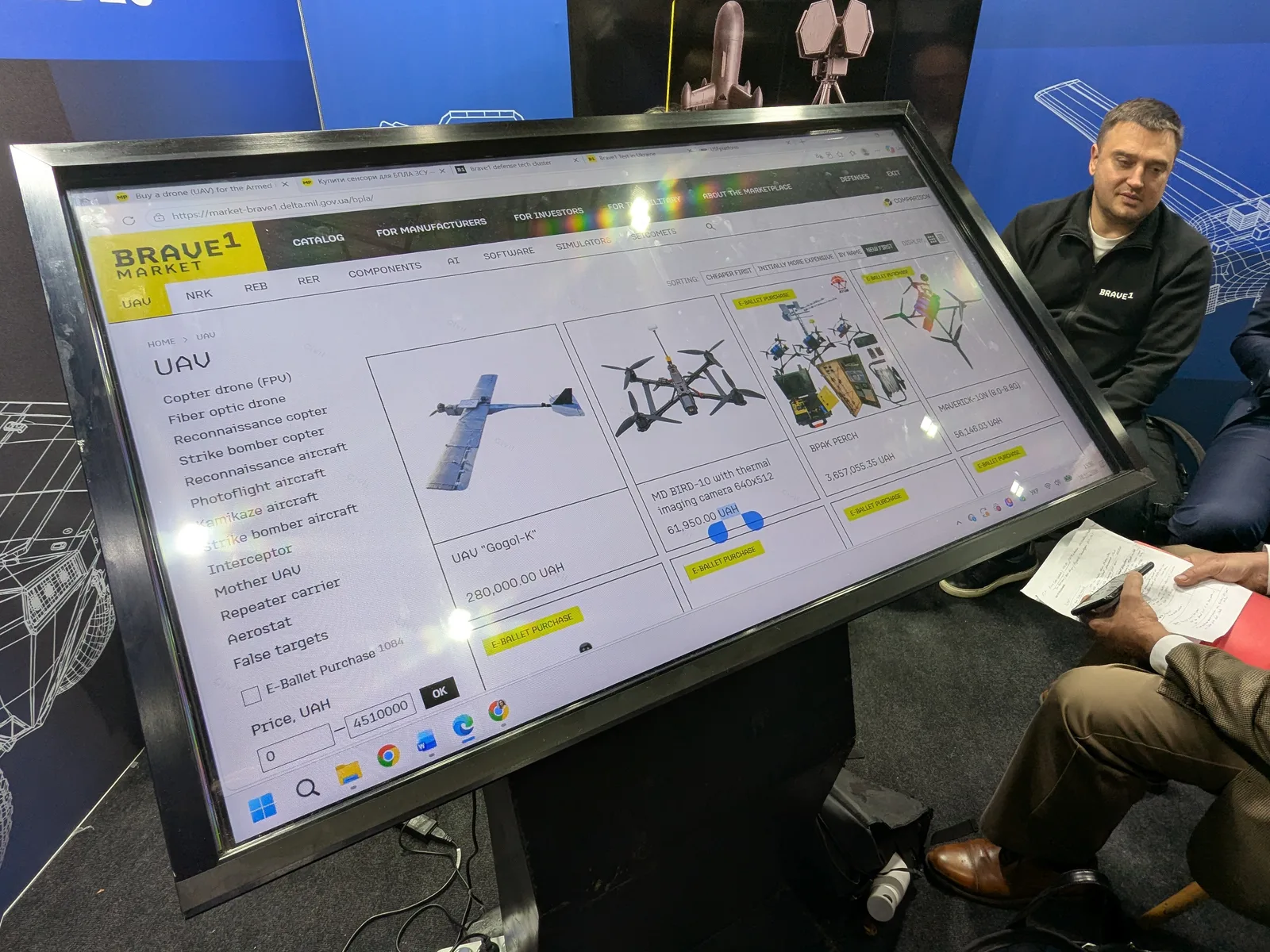
Brave1, for example, the Ukrainian state accelerator institution driving the development of new defence technologies, presented the Brave1 Market, where military units earn points for successful missions on the battlefield and can use these to acquire additional equipment for their operations. More than 400 Ukrainian military units are using this, which has so far accumulated a total procurement volume of over USD 1.3 billion (EUR 1.18 billion), including the delivery of more than 700,000 drones, unmanned ground vehicles and electronic warfare systems.
Brave1 has also stood up a ‘Test in Ukraine’ initiative: a platform that enables international defence companies to test their technologies in Ukraine and receive feedback from end users operating in real combat conditions. This then provides a pathway to further development and entry into Ukraine’s defence ecosystem.
Unite – Brave NATO, meanwhile, is a joint Brave1/NATO programme that connects Ukrainian and NATO-country companies to co-create innovative technological solutions. These are funded jointly through a Brave1 grant programme and the NCIA-administered Comprehensive Assistance Package (CAP) for Ukraine programme.
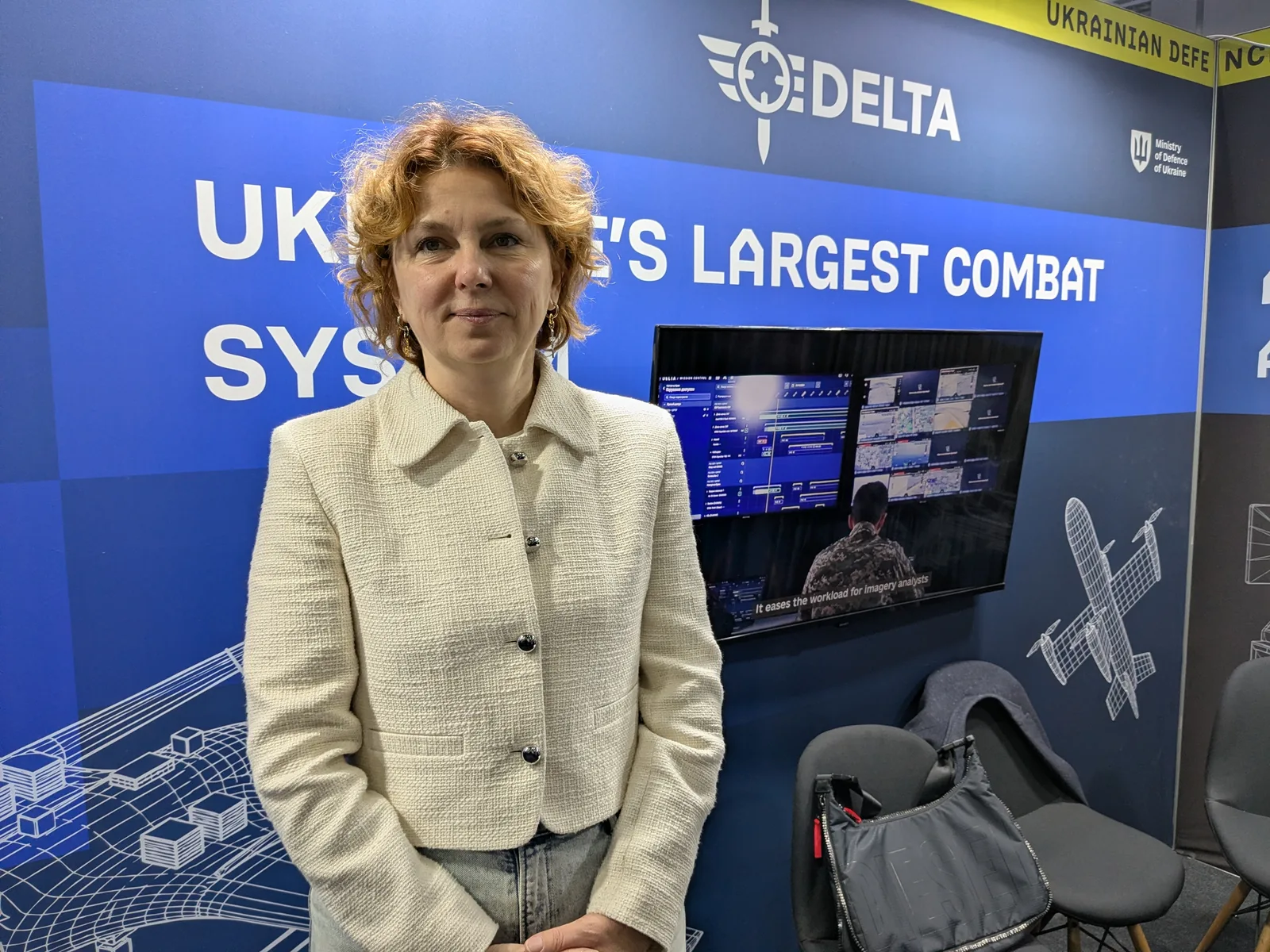
Also presented was Delta: a combat system deployed across all of Ukraine’s defence forces that serves as an integration platform for all battlefield data, bringing together various military developments in a single space. Consisting of 12 public modules, Delta has 300,000 active users, brings together more than 3.5 million drones streams every month and maps 11 million military objects every month, delivering, for example, comprehensive enemy loss statistics.
As described in Ukrainian MoD literature, Delta “meets the front line’s most critical needs: it saves soldiers’ lives, accelerates the kill chain and collects essential battlefield data for further analysis and improved data-driven decision making”.
Serhii Zahriichuk, chief technology officer at the Ukrainian MoD’s Centre of Innovations and Defence Technologies Development, told journalists at NATO Edge 26 that next year Ukraine is looking to offer Delta to its allies. The system, he said, would be offered government to government on an open-source basis, though without the Ukraine-specific data sets in order to prevent any chance of that intelligence falling into the wrong hands.
Also presented on the Ukraine stand was Avengers Labs: a platform for training AI models for unmanned systems using real battlefield data. Taking advantage of the fact that Ukraine is currently in the midst of a full-scale war, Avengers Labs “holds a vast repository of frontline data with real practical value for advancing defence technology, giving a significant edge in building AI-powered weapons”, according to Ukrainian MoD literature.
Oleksandr Bornyakov, chairman of the supervisory board of Brave1, additionally told journalists at NATO Edge 26 that a new Ukrainian initiative is to more comprehensively orchestrate unmanned systems to autonomously operate together, thus requiring fewer human operators having to be present to control them while in harm’s way on the front line.

Share post