The NATO Communications and Information Agency (NCIA) signalled at its NATO Edge 26 technology event, held in İzmir, Türkiye, from 17 to 19 November, that it expects to spend around EUR 2.7 billion over the next two years
The announcement aligns with priorities agreed at the NATO Ankara Summit in July 2026, where Allied leaders emphasised the need to strengthen NATO’s defence-industrial base, increase production capacity and accelerate the development and delivery of capabilities.
The NCIA has acknowledged that achieving these objectives requires closer engagement with industry and clearer indications of the future technologies and services that it requires. With that in mind the agency has now published a detailed list of procurement opportunities on its website.
The areas where the NCIA anticipates requirement to emerge include the following:
- Enterprise connectivity and networks: services and equipment to improve NATO’s network infrastructure, connect systems across the alliance and support deployable communications.
- Cyber defence and security: capabilities to strengthen network protection, improve security monitoring and support incident response.
- Intelligence, data and geospatial services: tools and data for open-source intelligence, imagery analysis, operational planning and understanding of the information environment.
- Satellite and tactical communications: satellite ground terminals, beyond-line-of-sight communications and secure tactical radio capabilities.
- Applications and operational support: software development and engineering, medical support systems, training services, identity management and the maintenance of NATO information services.
NATO Edge’s raison d’être
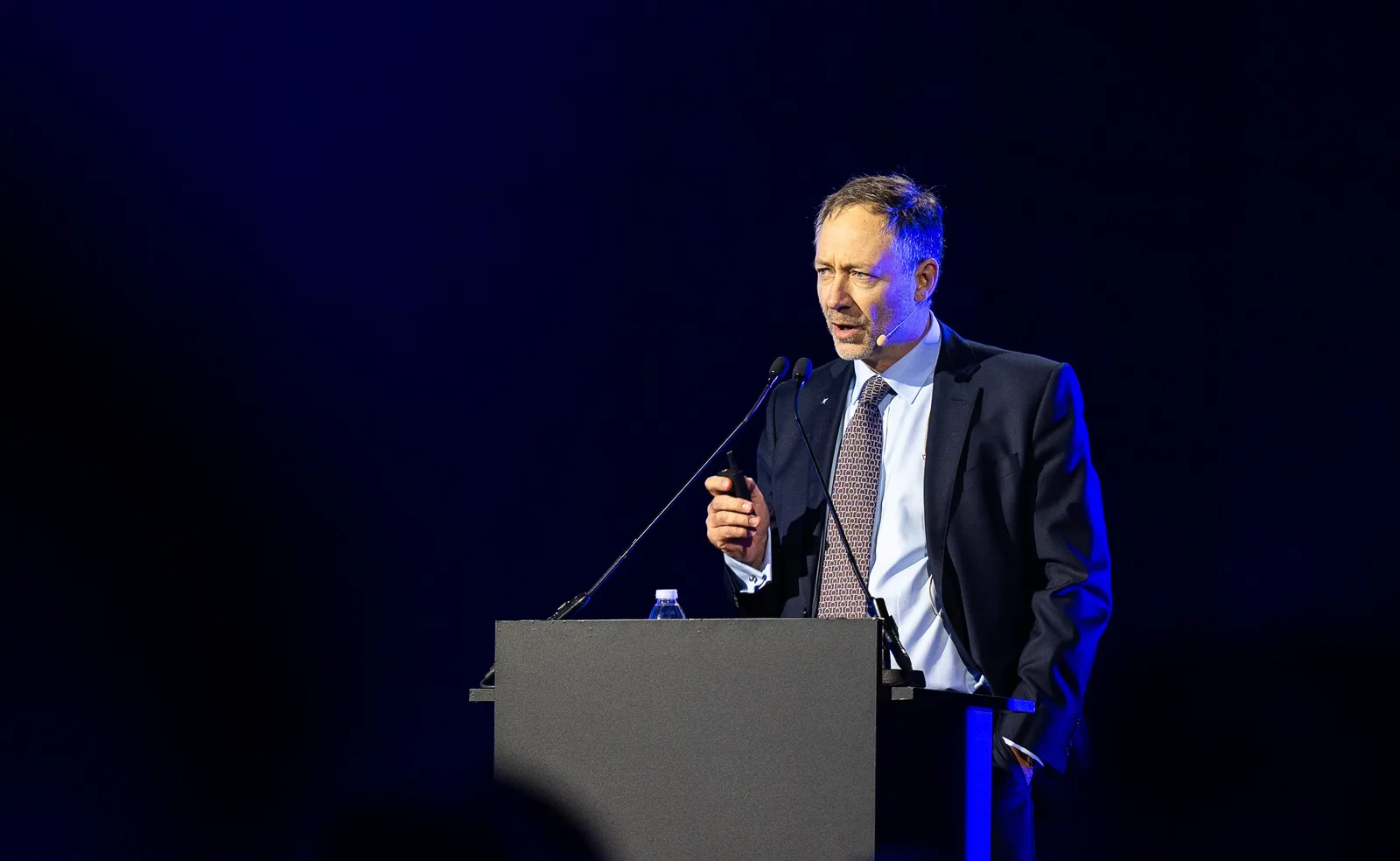
Speaking to invited journalists in İzmir on the eve of NATO Edge 26, NCIA General Manager Dylan Browne outlined the key goals of the conference as follows, “The security of our alliance is increasingly dependent on the ability to turn technology advantage into operational advantage. Technology is no longer simply supporting NATO’s mission; it is central to how we deter, defend and fight. So the question before us is therefore not whether technology matters; it’s whether we can deliver the capability that NATO needs at the speed and scale demanded by today’s security environment. And that … is what NATO Edge is all about.”
Underling the urgency of accelerating the development and delivery of capabilities, Browne said, “The character of warfare is evolving: artificial intelligence, cyber, space, cloud, autonomous systems and secure communications are changing how military forces operate, share information and make decisions. The battlefield is more connected, and the pace is moving faster. And the advantage increasingly belongs to those who can take technology from concept to capability, and from capability to operational effect, the fastest. And this is one of the central challenges facing the alliance today.”
Browne emphasised that achieving the required pace of capability development “requires closer engagement between NATO and industry. It requires clearer information about our future needs, and it requires faster, more effective pathways for bringing the right technologies into service. NATO Edge is where these priorities come together. It connects NATO’s strategic direction and operational requirements with the expertise, innovation, and capabilities of industry.”
He then noted four key messages guiding the activities at NATO Edge that week as follows, “First of all, NATO has significant capability ambition. Second, technology change is accelerating. Third, we must shorten the journey from requirements to capability. And fourth, industry is an essential partner in meeting this challenge.”
The NCIA, as NATO’s technology and cyber hub, has a central role to play in this regard.
“We deliver and sustain the digital infrastructure, communications, network, and services that allow the alliance to operate. We protect NATO’s networks. We strengthen the resilience of the digital environment, and we help connect capabilities across domains from headquarters to the tactical edge,” said Browne. “But the scale and speed of technological change means that no single organisation can meet the challenge alone. NATO must work with industry not only when a requirement has been finalised, but earlier. We’ve got to work closer with clearer understanding of what the alliance needs next. This means sending stronger demand signal, giving industry greater visibility of our requirements and future priorities, creating more opportunities to move rapidly from promising technology to operational capability. We are already putting this approach into practice. So, for the first time, NATO is sending a clearer and more ambitious demand signal to industry.”
In his keynote speech on the opening day of NATO Edge 2026, Browne appealed directly to the representatives from industry in the audience.
“We’re reaching further. We’re opening doors. We’re connecting NATO with the best that industry has to offer, and the opportunities are significant,” he stated. “Over the next two years I expect to bring EUR 2.7 billion of business to the market … in cloud, in AI, in cyber, command and control, in space, and the networks that connect them all. It is real. It’s funded, and it starts here this week.
“I know your reality,” he continued. “I know what it takes to win a contract, and I know what it takes to deliver on one; they’re not the same thing. Winning and delivering are quite different. So here’s what we need. First, I want you to bring your best technology. We don’t want last year’s product with a new label. We want your best: the work that you are most proud of. Second, bring your A team; bring your top leaders to accelerate decisions and signal your commitment, not only to win but to deliver. And third, performance on time, on budget, secure by design, interoperable from day one.
“Now, in return, we will offer you clarity, speed, and partnership,” said Browne. “We will hold ourselves to the same standards that we ask of you. Whether you’re a large company or small, whether you’re an established name or a new innovator, we want companies from all 32 allies. If you can deliver, you are in the right place.”
NATO Edge 26: ‘Not just another conference’
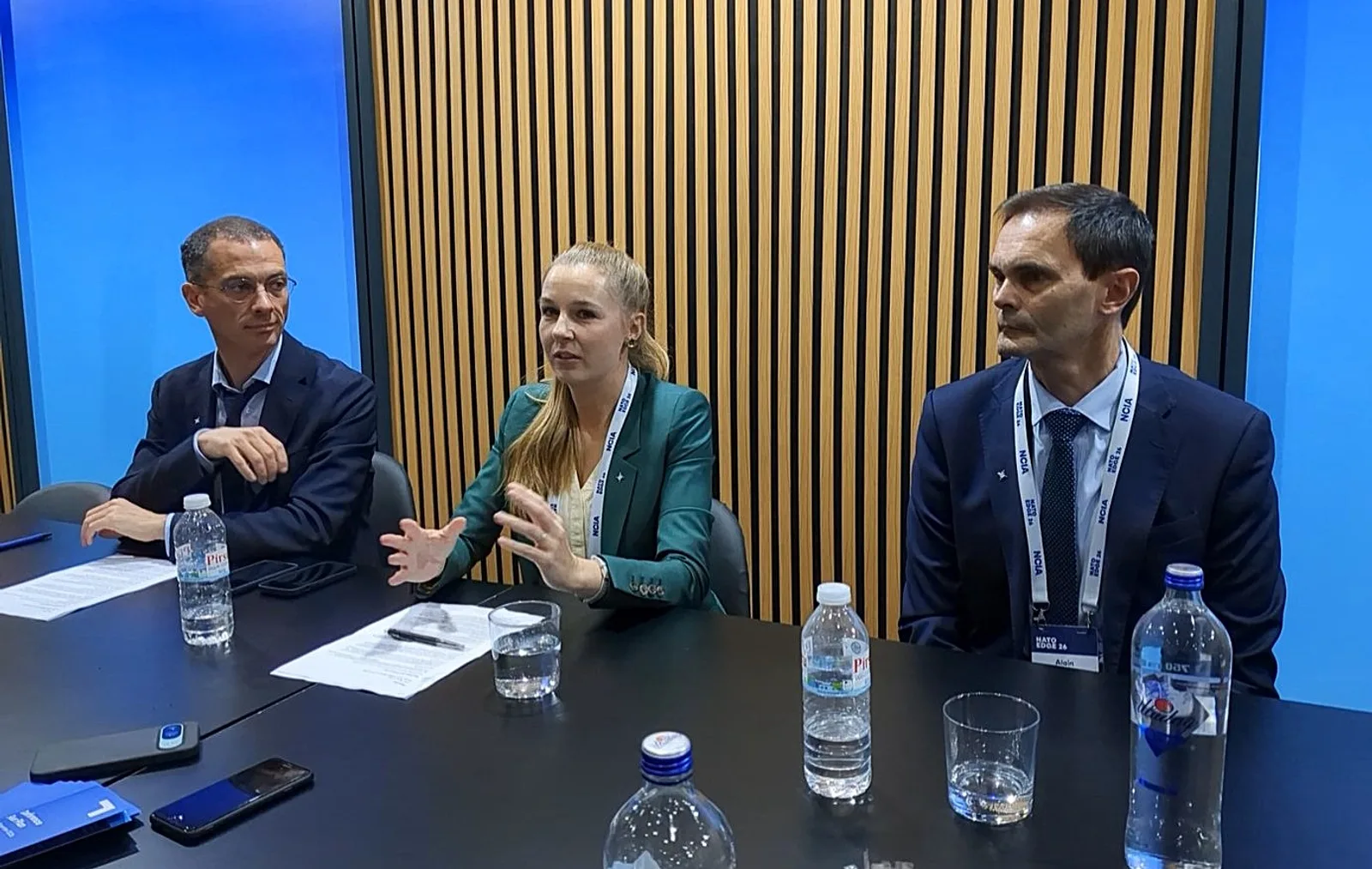
Speaking to journalists at NATO Edge 26 on 19 November, NCIA Chief of Acquisition Marianne Roth emphasised that “everything that we do is to make sure that the alliance is ready because we need to be ready to fight tonight. We’re here in full support and in alignment with the NATO transformation, NATO 3.0, and everything that you’ve seen at Edge is driving that forward: taking investment and turning it into combat-ready forces. At the end of the day, what we’re doing here is for the warfighter; it’s not about the targets that we’re setting and hitting those targets.”
Roth noted that the estimated EUR 2.7 billion worth of business opportunities brought to NATO Edge 26 is almost triple the amount signalled at the NATO Edge 24 event in Tampa, Florida.
“So you’re really seeing that increase in scale, some of the complexity that it’s bringing with it, but also the operational urgency that is driving that increase over the next two years,” she said.
Roth asserted that NATO Edge 26 was “not just another conference; it’s not just another networking thing. We wanted to make it a working-level event.”
“The aim is to be better engaged, have a better understanding of what the marketplace actually has to offer, and then solidifying those pathways to delivery,” she said. “We’ve heard that industry is ready, willing, and wants to share information, and that’s what we’ve done here at Edge.”
Explaining the NCIA approach to its upcoming procurements, Roth said, “You’ve maybe heard about this ‘Adopt, Buy, Create’ – ABC – model. We’re really heavy on the A and the B of that: looking to adopt and buy.”
“Ultimately, what we’re doing with these demand signals and these demand areas is connecting our forces, and that’s what we’re here for.”
Stressing the need for the NCIA to be more agile and innovative, Roth said, “Procurement can no longer be the bottleneck. We have to be one of the mechanisms that deliver. And we’re getting initial positive feedback from industry. We’re doing things like a phased approach to solicitations, as well as oral presentations. These are all things that industry responds to really, really well, and it helps us speed up and be able to make better decisions and have better discussions with industry on what the tech is actually bringing.
“And NATO Edge is one of those forums that exemplifies exactly that feedback from industry and how we take it into practice,” Roth added. “The next step after this is to take what we’ve done here and turn it into actual and visible requirements, practical further continued practical engagements with industry. So this is just kind of a big culminating moment. So the way [industry] can do this is reviewing demand signals. They can monitor our procurement notices, both NCIA’s and NATO’s, and then also by just staying engaged. … The best way to for industry to engage is to actually submit proposals. There’s a wealth of information that you get by just going through the process.”
Emphasising interoperability, resiliency and scalability, Roth said the NCIA is “expecting industry to deliver and we need to deliver with them, and we have to hold both sides accountable to doing that”.
Buying services as opposed to hardware
At NATO Edge 26 it was abundantly clear that, in order to effect the kind of agile procurement dictated by the current military-geopolitical paradigm, the NCIA is pulling out all the stops to truly partner with industry in pursuit of its goals. However, the agency is largely looking to buy vital services as opposed to the actual hardware on which those services depend. In many areas this won’t be an issue, but in others it certainly could be.
For example, regarding space-based services that are reliant on satellites not directly owned by the defence ministries of NATO allies, industry will inevitably have to bear the cost of launching, operating and maintaining those satellites in a space domain that is increasingly threatened by the prospect of hostile action by adversaries such as Russia and China. This, inevitably, will introduce an element of additional risk in providing those services.
Asked about this issue, Roth replied that, in terms of the potential risk to a commercial company’s spaced-based assets, “That is a business decision that the company needs to make on what costs they transfer to us and what they choose to maintain in house. That is not something that we step into.”