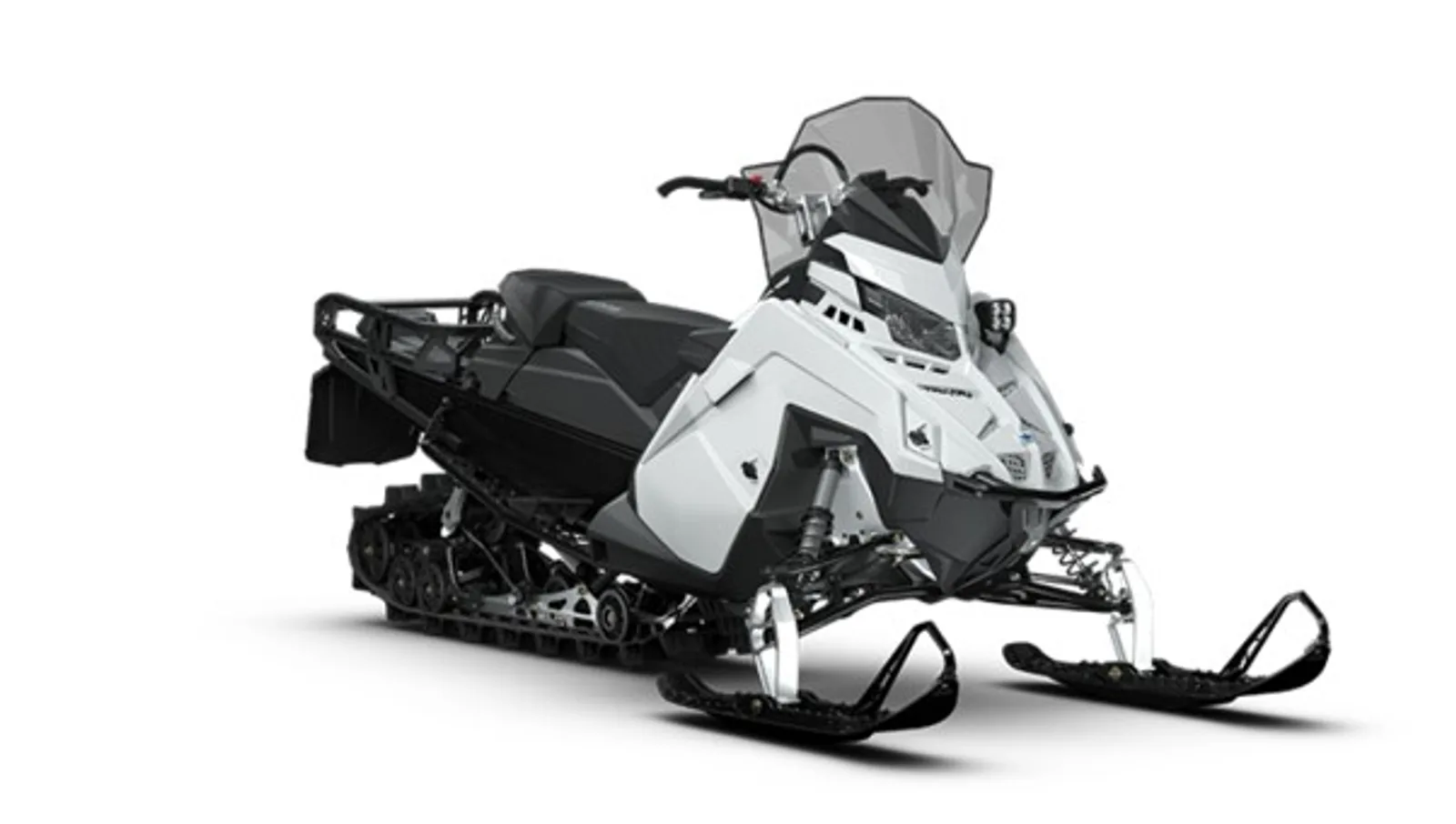
Polaris Government and Defense introduced a new military snowmobile, the Military 850 Voyageur 155 Crossover, in the second week of September 2026.
Speaking to Warsight at the Defence Vehicle Dynamics (DVD) 2026 event at UTAC Millbrook Proving Ground in Bedfordshire on 16 September, Steve Canner, the company’s manager for international government and defence sales, explained that the Military 850 Voyageur (or M Voyageur) fills a gap between the two snowmobile platforms that were already in the Polaris line-up.
“Previous to this launch, we had two military-specific snowmobiles: the Military Titan and the Military RMK,” said Canner. “Titan is very much a utility platform, so if you’re towing baulks, you’ve got to carry two people, you’ve got kit you want to move around, then that’s the workhorse; and then the RMK is very much a mountain sled; if you’re in very soft snow, you don’t have any kind of payload requirement, and it’s a reconnaissance kind of setup, then that would be that platform. What we didn’t have was something that sat in the middle of those: something that’s still capable in the softer mountain snow, but also has a level of payload and can tow things, so that’s where the Voyager fits in; the M Voyageur is that crossover sleigh.”
Derived from the civilian Polaris Voyageur snowmobile, the M Voyageur is essentially militarised by featuring white panels, being able to operate in blackout mode (where a single switch instantly turns off all lights for discreet operation) and having a wide-beam infra-red headlight, allowing the driver to operate in darkness using night vision goggles.
The M Voyageur features an 850 cc two-stroke engine that gives it the payload capacity for a driver, passenger and stowed gear, as well offering a towing capacity of 450 lb (204 kg), while 12 V outlets allow the powering or charging of hand-held electronics and other mission-essential devices. The M Voyageur has a dry weight of 261 kg and a fuel capacity of 43.5 litres.
Once Polaris had finalised the configuration of the M Voyageur, the company didn’t have to wait long before it picked up orders. The US Army has ordered 50 of the new snowmobiles, as well as 25 Military 850 Titan 155 snowmobiles and more than 30 of the company’s Ranger utility vehicles. Multiple contract mechanisms were leveraged for these sales, the company noted in a press release, and vehicles have already begun being delivered, with all deliveries planned to be complete by the end of the year.
Meanwhile, the US Marine Corps has also placed a new order for 60 military snowmobiles – comprising 20 each of the M Voyageur, M Titan and M RMK – to be delivered to units based in Norway. In addition, the US Air Force has ordered Voyageur snowmobiles for its 57th Rescue Squadron in Italy in support of its combat search and rescue, personnel recovery and casualty evacuation missions.
Beyond the M Voyageur
While the M Voyageur certainly fills a gap in military snowmobile requirements, Canner noted that Polaris is currently looking to what will be required from its customers in terms of Arctic/High North mobility in future, particularly as the effects of global warming are felt. This most specifically is looking to address conditions in what is known are ‘the shoulder seasons’: the rapid periods of transition between the two dominant Arctic seasons of winter and summer.
“When they’ve got snow, it’s easy; there’s lots of platforms out there that will operate in different types of snow, soft snow, deep snow, whatever,” Canner explained, “but it’s the when the snow is melting, or when it’s melted; that’s where the gaps lie.
“That’s something we’re looking at now as a long-term plan over the next three five years, to look at how we can work with those users to develop [new platforms], or to take existing product and make it so that it is compatible with those environments. That’s something that we are actively, consciously investing in, and we will be working in Alaska predominantly on various NATO opportunities to join exercises and things like that. We’ll be doing that starting in January.”
At this point Polaris does not know what form that solution will take.
“We’ve explored different options in the past,” said Canner, “and whether it’s a wheeled vehicle that can be optionally tracked, or whether it’s a fully tracked vehicle, or whether it’s a 6×6 or whatever that might look like, we need to understand exactly what those conditions are and what the constraints of those conditions will be for a vehicle.”