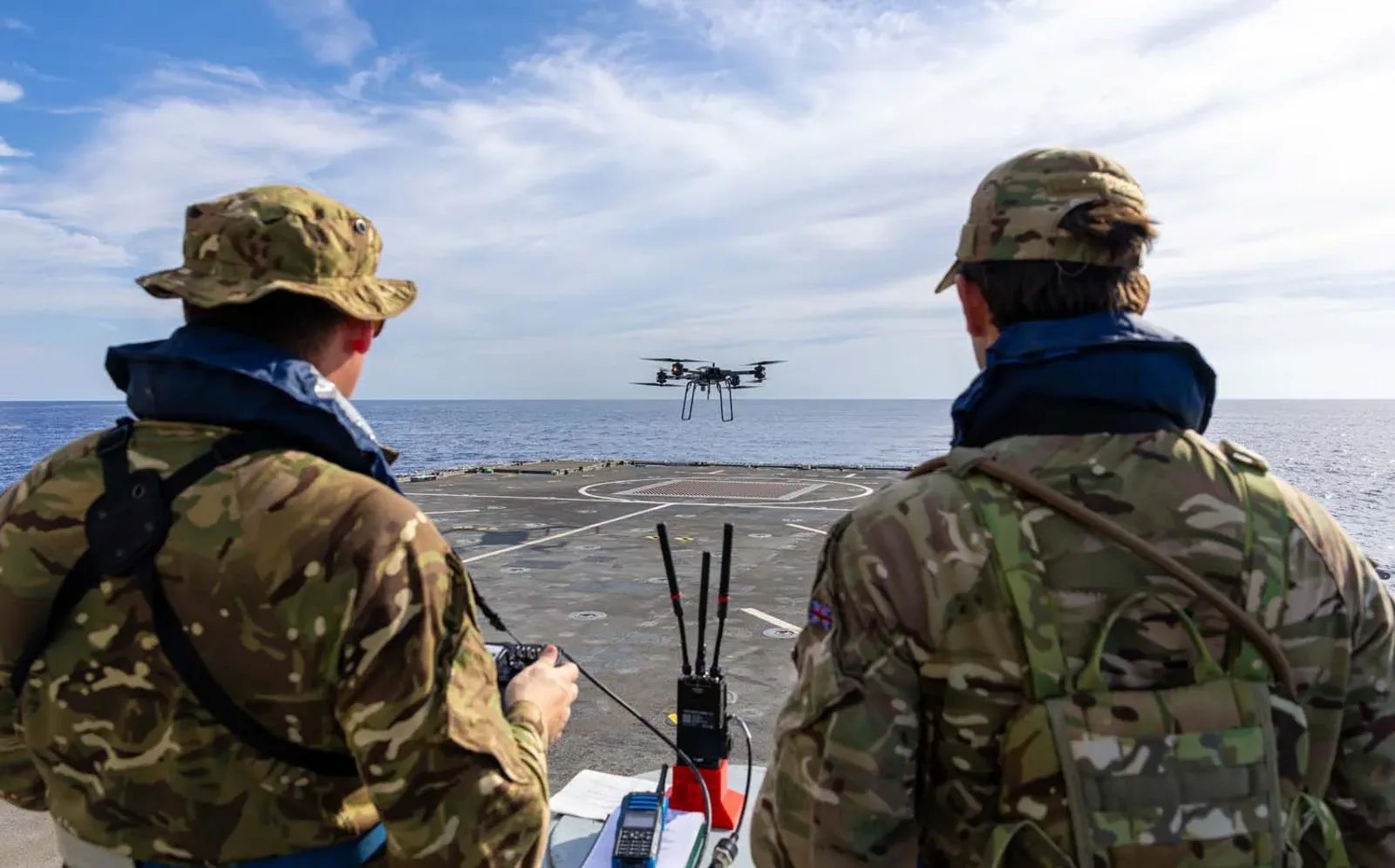
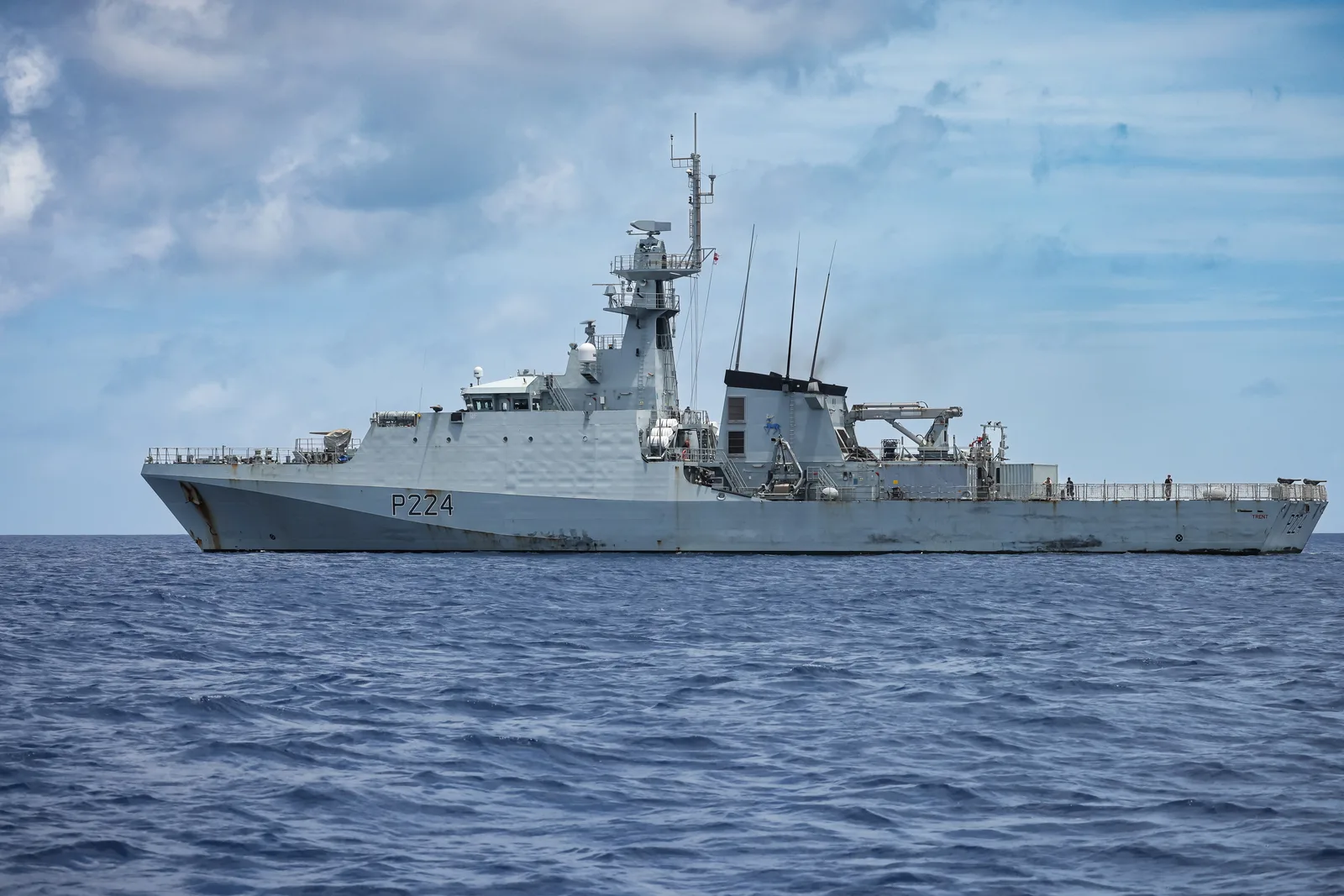
The UK Royal Navy (RN) has successfully operated its Malloy T-150B uncrewed aerial vehicle (UAV) capability from a River-class Batch 2 offshore patrol vessel (OPV) for the first time. The capability was embarked in HMS Trent while the ship is deployed in the Caribbean region, including to provide humanitarian assistance and disaster relief (HADR) capacity during the hurricane season, according to the RN.
The ability to deploy the Malloy from the OPVs expands the navy’s capacity to operate the UAV. This capacity currently includes the two Queen Elizabeth-class aircraft carriers. The system was present onboard HMS Queen Elizabeth for its Carrier Strike Group 25 (CSG25) Indo-Pacific deployment in 2025, and onboard HMS Prince of Wales for its Operation ‘Firecrest’ mission in the North Atlantic and Arctic earlier in 2026. During CSG25, Malloys were deployed onboard the Tide-class auxiliary ship RFA Tidespring, too; during ‘Firecrest’, the capability was also embarked in the Type 45 destroyer HMS Duncan.
These operational deployments with the Malloy UAV demonstrate the navy’s capability to operate the system on various different platforms, in various different regions, in various different operational contexts.
In those instances listed, the UAVs were used for ship-to-ship logistics movements. What is perhaps most notable about the Trent embarkation is that the UAV will bring ship-to-shore logistics capability, in the HADR role.
Capability step
The RN has been actively looking to expand its operational capability with Malloy, and the Trent deployment represents the next step. In a statement, the RN said: “This milestone activity marks a significant step forward in the navy’s exploration of uncrewed aviation capability at sea.”
The T-150B is a heavy-lift octocopter, used in RN service to provide logistics support, carrying payloads up to 63 kg via a clip fitting on the UAV’s underside. However, onboard Prince of Wales during ‘Firecrest’, the UAV was fitted with a 15 m, drop-down cable to enable payload delivery without the UAV needing to land onboard the vessel – or the shore location – it is delivering to. It also enables the UAV to carry larger loads (although of the same maximum payload weight).
The T-150B has a range of up to 37.5 km, depending on payload weight, and can operate in winds of up to 15.4 m/s (30 kn). Its thermal imaging sensor also enables day/night operations.