MICA NG test fired at supersonic speed from a Dassault Rafale

In the second development firing of a MICA NG missile, the French Direction Générale de l’Armement achieved a successful first supersonic firing of the weapon.

The first supersonic firing of a MICA NG missile was made from the first Rafale M, operating from Solenzara on the island of Corsica. (Base Aérienne 126, Armée de l’Air et d’Éspace)
Jon Lake

On 1 June 2026 the French Direction Générale de l’Armement (DGA) announced the successful first supersonic firing of an MBDA MICA NG air-to-air missile. This was the second development firing from a Dassault Rafale fighter, the first development shot having taken place in June 2025.

The successful supersonic firing of a MICA NG missile announced by the French DGA on 1 June 2026 was the weapon’s second development firing from a Rafale. (MBDA)
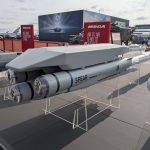
The second MICA NG test round was painted dayglo orange and light grey, with black and white camera calibration markings. (MBDA)

The MICA NG (Missile d’Interception, de Combat et d’Auto-défense, Nouvelle Generation, which translates as Missile for Interception, Combat and Self-defence, New Generation) is a second generation of the original MICA, designed to be more capable against stealthy and high-speed air targets. Development of the MICA NG formed part of a wider programme to modernise sovereign French defence capabilities in the face of evolving threats and in contested and high-intensity airspace.

Like previous MICA variants, the MICA NG will be available for air-to-air and surface-launched applications, with a dedicated VL (Vertical Launch) MICA NG version, while old and new variants will be interoperable.

The VL (Vertical Launch) MICA can be deployed on land as part of a tactical operations centre (TOC). It can be fitted with either a heat-seeking homing head (VL MICA IR) or with an active radar seeker (VL MICA RF), giving significant flexibility. (MBDA)
The ship-based VL MICA is typically fired from a modular vertical launch system and can integrate directly with a vessel’s existing combat management system without the need for dedicated tracking or illuminating radars. (MBDA)

Also like the original MICA, the MICA NG will be built in two versions with two guidance systems and two interoperable seekers: an infra-red (IR) seeker and an active radio frequency (RF) seeker. The IR variant uses a matrix sensor providing greater sensitivity, while the RF variant has an active scanned-array radar.

The MICA NG is said to provide unsurpassed tactical flexibility in order to meet the most demanding operational requirements and has expanded capabilities against targets with very low infrared and electromagnetic signatures, including stealth fighters, drones and cruise missiles.

The weapon offers enhanced beyond-visual-range (BVR) performance, enhanced short-range (SR) performance and multi-target capabilities.

The IR-guided MICA NG offers a passive, stealthy BVR capability thanks to a silent IR seeker. In shorter-range combat situations the missile offers lock-on-before-launch and lock-on-after-launch modes, as well as excellent acquisition and tracking performance across a 360° launch envelope.

The missile’s IR seeker can transfer IR imagery to its central data processing system, providing an infra-red search and track (IRST) capability to the Rafale pilot and thus operating as an extra sensor.

Meanwhile, the range of the MICA NG has been increased by up to 40% more than the standard MICA, with the new missile’s dual-pulse rocket motor boosting both range and end-game performance. It has been estimated that the original MICA IR had a range of about 60 km, while the NG could reach 80-90 km, enabling the weapon to exploit the 100 km range of new-generation passive sensors, including the latest version of the Rafale’s OLS50.

During supersonic flight the MICA NG and its IR seeker are subjected to higher ambient temperatures, reducing the contrast between the target and the IR ‘background’ and making it more difficult for the seeker to detect.

The supersonic missile test-firing, conducted by the DGA in collaboration with MBDA, Dassault Aviation and French Air and Space Force teams, was reportedly made under ‘highly demanding’ operational conditions. The performance of the MICA NG’s IR seeker was successfully evaluated in supersonic flight and its capabilities against all types of current and future threats were validated. The firing thus represented a major step towards achieving full integration and qualification on the Rafale.

The MICA missile has never been a cheap weapon. Some French state sources give a MICA unit price of EUR 600,000 to EUR700,000 and others give a unit cost of EUR 1.5 million to EUR 2 million (USD 1.6 million to USD 2.2 million), while it is understood that India paid EUR 1.9 million per MICA missile.

The MICA NG programme cost USD 1.8 billion for batches of 200 and 367 missiles, giving a unit price of EUR 3.174 million!

The first MICA NG test round was fired from a Rafale in June 2025. (Armée de l’Air et d’Éspace)
A radar-guided MICA EM being fired from a Dassault Rafale. (MBDA)
The first MICA NG test firing was made from a Rafale in June 2025. (MBDA)
The first MICA NG test round captured by the camera carried by the target, just before impact. (MBDA)

Share post

You may be interested in

Categories

All NewsAir

Used tags

Dassault RafaleFrench Direction Générale de l’Armement (DGA)MBDAMICA NG
Ad

Similar posts