Unmanned surface/underwater vehicles (UxVs) were a major draw at SAHA EXPO 2026 in Istanbul. Several exhibitors showed concepts ranging from expendable one-way-attack (OWA) unmanned underwater vehicles (UUVs), extra-large autonomous underwater vehicles (XLUUVs), and high-speed unmanned surface vessels (USVs) designed for strikes and port protection. The systems on display emphasised endurance, modular payloads, and operation in contested electromagnetic environments, alongside the ability to integrate into wider unmanned fleets.
Expendable underwater munition concepts: The Kılıç family
In the expendable underwater category, Turkish defence giant Aselsan presented the Kılıç family of OWA UUVs in two variants intended for different mission profiles.
Kılıç 10 was positioned as a portable, rapidly-deployable underwater munition optimised for asymmetric and covert operations. The concept brief highlights single-operator employment and a sensor and communications package intended to support detection and engagement in low-visibility conditions. The stated suite includes periscope-mounted thermal and infrared cameras, underwater low-light imaging, and acoustic communications.
Control and employment modes were also highlighted. Kılıç 10 is described as having radio frequency (RF) control, an optional wire-guided mode, and the ability to operate autonomously, including as part of a swarm. The platform is presented as having low acoustic and low visual signatures, and an integrated warhead intended for precision neutralisation of surface and subsurface targets.
Kılıç 200 takes the same design logic and pushes the concept further in terms of longer range and greater payload capacity. It is described as suitable for engaging a broader set of target types, including subsea infrastructure, port facilities, and offshore energy assets.
A key difference noted in the concept description is deployability via USVs, pointing to an approach where an unmanned ‘mothership’ can carry and release the underwater vehicle closer to the operating area. Like the smaller variant, Kılıç 200 was presented with autonomy, modularity, advanced navigation, acoustic communications, and swarm operation as core attributes.
USVs for ISR and strike: Tufan
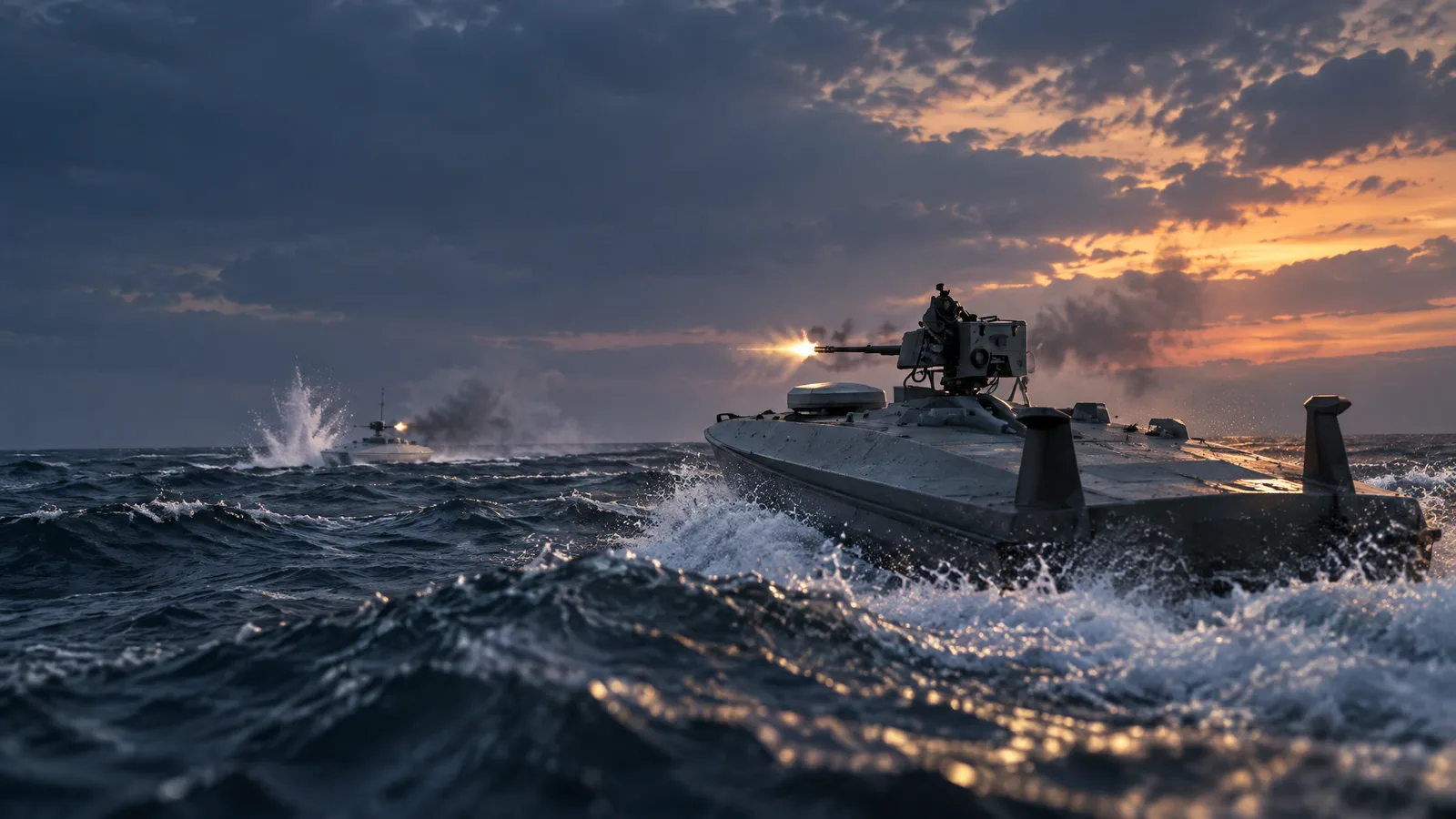
Aselsan also showcased a USV platform, Tufan, described as intended for offensive missions as well as intelligence, surveillance, and reconnaissance (ISR). The platform is described as 8.1 m in length, powered by a gasoline engine and waterjet propulsion, with a focus on speed and manoeuvrability for both littoral and open-water use.
Tufan’s concept centres on autonomy and group operation. It is described as able to operate alone or in coordinated swarm formations, including the ability to form mission-oriented subgroups to execute parallel tasks such as reconnaissance, surveillance, and strike. Vision-based systems are used for autonomous navigation functions such as obstacle avoidance and target detection. The vehicle is also described as carrying an insensitive high-explosive warhead for engaging surface targets and coastal infrastructure, and possessing a modular architecture intended to support integration into broader naval command and control (C2) networks.
Endurance-focused underwater platforms: Tengiz XLUUV
At the other end of the size spectrum, STM introduced Tengiz, an Extra Large Unmanned Underwater Vehicle (XLUUV) aimed at persistent operations. The platform is described as having an operational depth exceeding 400 m and endurance over 20 days, enabled by high-capacity energy storage.
STM’s description places Tengiz firmly in the strategic underwater category: 11.2 m long, 1.6 m in diameter, and 17.8 tonnes displacement, with speed stated as over 8 kn (15 km/h). Mission sets listed include ISR, target tracking, and patrol duties linked to anti-submarine warfare, as well as electronic warfare (EW), signals intelligence (SIGINT), seabed mapping, and inspection of critical underwater infrastructure (CUI). STM also describes a mine warfare role, with Tengiz capable of deploying mines into designated transit routes.
A notable aspect of the concept is a ‘mothership’ architecture. STM states Tengiz can house and deploy the Neta 300 (a smaller UUV developed by STM) and the Rocketsan Alpagut fixed-wing loitering munition while submerged. Integration into a network-centric construct is via the ADVENT combat management system and SATCOM. STM also emphasises strategic mobility in the form of compatibility with 40-ft ISO container dimensions and the ability to deploy from port facilities, logistics support vessels, or well-deck-equipped ships such as TCG Anadolu (LHD).
High-speed OWA USVs: Yaktu and Cellat
The USV segment at SAHA also included systems presented explicitly as OWA assets.
STM’s Yaktu was presented as a swarm-capable OWA USV optimised for strikes against surface targets. It is described as 5.8 m long with a displacement of 1.7 tonnes, >50 kn (93 km/h) maximum continuous speed, >20 kn (37 km/h) service speed, and a range of 200 nautical miles (370 km) at 20 kn. Propulsion is described as a diesel engine paired with a waterjet. STM’s defining feature for Yaktu is swarm intelligence, including real-time data sharing and autonomous task allocation among multiple units, supported by both line-of-sight communications and SATCOM.
Kayacı Defence exhibited the Cellat OWA USV for the first time at SAHA. The platform measures 5 m in length and 1.7 m in width, reaches around 50 kn (93 km/h), has a range of 450 nautical miles (833 km), and can operate with 500 kg payload capacity. The report also noted that testing was ongoing and that the company aimed to make the platform mission-ready within roughly two months.
Datum’s Sinarit: A modular XLUUV concept
Another XLUUV concept described at SAHA was Sinarit, introduced by Datum as a modular, payload-focused XLUUV. In the company’s description, SINARIT is positioned as part of a broader effort to translate the space and volume freed by removing a human crew into a practical ‘underwater cargo’ concept.
A key point in Datum’s presentation is transportability. Sinarit is described as fitting into a standard truck container and being transportable by A400M aircraft, emphasising expeditionary logistics. The vehicle features 3.8 m modular payload bays that allow the platform to be configured for different roles. Datum’s chairman characterised the concept as an ‘underwater pickup’, framing Sinarit as a platform intended to carry whatever payload is fitted to a chosen location covertly via underwater transit.
Datum also describes Sinarit as designed with low acoustic signature to reduce sonar detectability. The modular payload approach is presented as supporting up to 12 payload types, with examples spanning mine warfare, torpedo carriage, ISR packages, and strike payload concepts. The company’s examples included laying Malaman mines, carrying Akya and Orka torpedoes, surfacing for ISR using optronic sensors referenced as Aselsan’s Mercan family, employing a synthetic aperture sonar and remotely-operated vehicle (ROV) for mine clearing operations, and missile carrier payload concepts referencing munitions such as Atmaca, Çakir, Gezgin, and Gökdoğan.
Unmanned ambitions
Across the unmanned maritime systems shown at SAHA EXPO 2026, the exhibits covered a wide operational spread: from expendable underwater munitions, UUV-launched subsurface strike concepts, long-endurance XLUUVs with mothership roles, and swarming-capable high-speed USVs for rapid engagement. With similar trends having been observed outside Türkiye, a common question now is whether technology is currently outpacing concepts of operations.