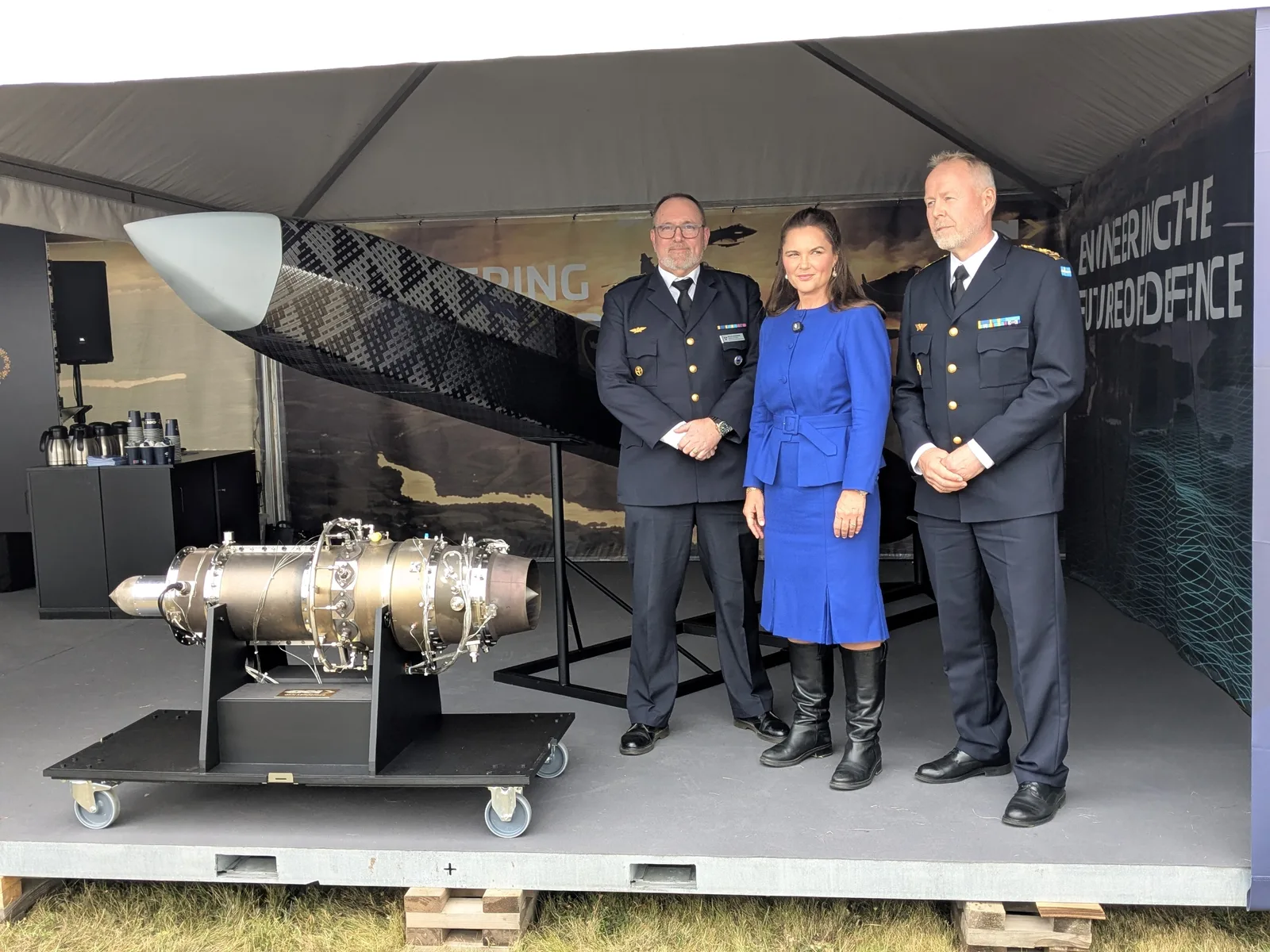
GKN Aerospace has unveiled the unmanned aerial vehicle (UAV) demonstrator it is developing under a collaborative programme with the Swedish Defence Materiel Administration (FMV) known as Project Otto. A full-scale mock-up of the cruise-missile-like demonstrator along with its dedicated turbojet engine were shown publicly on 21 August 2026 at the Jubilee Air Show at Malmen Air Base in Linköping, where the Swedish Air Force was celebrating its 100th anniversary.
The UAV demonstrator programme was initiated in November 2025 under a roughly SEK 150 million (EUR 13.6 million) FMV contract with the objective of the project coming to fruition within 18 months. Brigadier General Carl-Fredrik Edstrom, director of the FMV’s Air and Space Systems Division, told journalists at Malmen Air Base on 21 August that the demonstrator would make its first flight “not later than the beginning of next year”.
Rather than being directly intended as a future product, GKN’s UAV demonstrator is intended to be a flexible platform for testing and evaluation that provides valuable experience in how complex aerospace systems can be developed, integrated and manufactured affordably and on accelerated timelines. GKN engineers with propulsion, aerostructures and systems integration expertise from the company’s sites in Sweden, the Netherlands, and the UK have all contributed to the project.
While gaining that experience is the project’s primary objective, Gen Edstrom noted that if testing of the system goes well, and the Swedish armed forces identify a relevant requirement, the UAV demonstrator could go on to be developed into a deployable system such as a low-cost one-way effector, with options that include both ground- and air-launched concepts.
The demonstrator, meanwhile, is designed to fly at subsonic speeds and carry a 100-300 kg payload to ranges of between 600 and 1,000 km.
Joakim Andersson, president of GKN Aerospace’s Engines sector, noted that – just like the demonstrator itself – its powerplant had been developed from scratch since November 2025. Saying he was “very pleased” with how the turbojet is running so far, Andersson explained that a significant proportion of the powerplant has been additively manufactured and that multiple additive manufacturing and fabrication techniques have been used in that process, which he likened to using “all the tools in the toolbox”.
GKN Aerospace and Sweden
GKN Aerospace has a decades-long history of working with the FMV and the Swedish armed forces, having acquired Volvo Aero in October 2012. Volvo Aero (now GKN) has built and supported the RM12 turbofan (a version of the US General Electric F404) used by Sweden’s Saab Gripen C/D fighters since the 1980s as well as the RM16 turbofan used by the Gripen E/F (which is a version of the General Electric F414G).