An urgent US Air Force programme to fit a probe-and-drogue air refuelling capability to the A-10 close air support aircraft has come to fruition.



An urgent US Air Force programme to fit a probe-and-drogue air refuelling capability to the A-10 close air support aircraft has come to fruition.

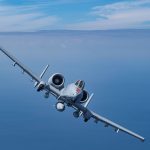
The US Air Force has tested a removeable air-to-air refuelling (AAR) probe for the A-10C Thunderbolt II close air support aircraft.
The modification effectively converts the aircraft from its standard boom refuelling configuration to being compatible with the probe-and-drogue refuelling system. This allows the A-10C to refuel from any drogue-equipped tanker, including from the underwing WARPS pods on the KC-46, significantly expanding refuelling options for deployed Thunderbolt II units. In particular, the new probe adapter allows an A-10 to refuel from a C-130 tanker, the airspeeds and altitudes of which are more compatible with A-10 operations. The HC-130J Combat King II, tasked with combat search and rescue (CSAR) and personnel recovery, and the MC-130J Commando II, tasked with special forces support, also align more closely with the close air support and CSAR operations flown by the A-10C.

The A-10 has hitherto been able to refuel only from the KC-135 Stratotanker, since the KC-10 Extender has been retired and certification of the KC-46 Pegasus is still pending after early ‘stiff boom’ issues, which prevented the relatively lightweight, thrust-limited A-10 from refuelling in some circumstances.
The chosen solution consists of a new probe refuelling adapter that fits into the refuelling receptacle on the nose of the A-10C. This is offset slightly to starboard from the aircraft centreline and does not intrude into the field of view of the pilot’s head-up display.
The rapid, multi-organisation effort that delivered a probe-and-drogue air refuelling capability to the A-10 Thunderbolt II was undertaken under the auspices of the Air National Guard Air Force Reserve Command Test Center (AATC), which is responsible for operational flight test, tactics development and evaluation for all Air Reserve Component (Air Force Reserve and Air National Guard) weapon systems. The effort had been underway over a two-year period, according to Senior Master Sergeant Charles Givens, public affairs manager at the AATC.
He added that the programme had been launched in response to an urgent requirement from an unspecified combatant command to address limited aerial refuelling options and availability for the A-10 in theatre.
The new probe adapter is a field-configurable solution and is designed for rapid installation by flightline personnel. The adapter can be installed or removed in a matter of hours, allowing A-10Cs to be reconfigured between boom and probe refuelling capability according to mission requirements.
Development of the adapter was undertaken on an expedited and compressed timeline, with the AATC co-ordinating the effort across multiple organisations to ensure a rapid outcome. These compressed timelines reflect the need to deliver capability rapidly in order to ensure that the US Air Force maintains its warfighting advantage.
The A-10 System Program Office (SPO) provided engineering oversight for aircraft integration, while ARCWERX, the Air National Guard’s innovation support organisation, enabled rapid contract acquisition. An unnamed industry partner developed and built the probe adapter and Luke Air Force Base fabricated supporting components to accelerate delivery.
Lieutenant Colonel Luke Haywas, the director of the A-10 Combined Test Force, explained, “Once the combatant command issued the requirement, all of the standard acquisition processes began immediately, but everyone involved understood the urgency. The SPO, ARCWERX, industry partners and supporting units each brought critical expertise to the effort. Nothing was shortcut or compromised from a technical or safety standpoint. We just accelerated every step we could.”

The A-10 Probe Refuelling Adapter was first demonstrated in the air on 2 April 2026, fitted to an A-10C (79-0185) from the Idaho Air National Guard’s 190th Fighter Squadron, part of the 124th Fighter Wing, based at Gowen Field Air National Guard Base (ANGB). The aircraft flew with a Lockheed Martin HC-130J of the 418th Flight Test Squadron, 412th Operations Group, from Edwards AFB, California. Further test flights will be undertaken before the device becomes available for operational units.
Colonel Daniel Wittmer, AATC commander, stated, “This project demonstrates that AATC can serve as a rapid response mechanism when combatant commanders face urgent capability gaps. We maintained relationships with system program offices and industry partners, and we brought the test expertise needed to move from concept to fielded capability in weeks. That’s not a one-time accomplishment; it’s a model for how the air force can deliver operationally relevant capabilities to warfighters at the speed that modern conflict demands.”